

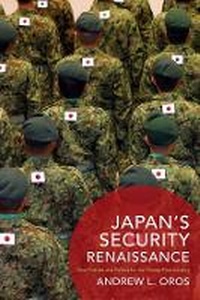
Japan's Security Renaissance
New Policies and Politics for the Twenty-First Century
Will be published approx. on 7. March 2017
Book
Hardback
320 pages
978-0-231-17260-8 (ISBN)
Description
For decades after World War II, Japan chose to focus on soft power and economic diplomacy alongside a close alliance with the United States, eschewing a potential leadership role in regional and global security. Since the end of the Cold War, and especially since the rise of Prime Minister Shinzo Abe, Japan's military capabilities have resurged. In this analysis of Japan's changing military policy, Andrew L. Oros shows how a gradual awakening to new security challenges has culminated in the multifaceted "security renaissance" of the past decade. Despite openness to new approaches, however, three historical legacies-contested memories of the Pacific War and Imperial Japan, postwar anti-militarist convictions, and an unequal relationship with the United States-play an outsized role. In Japan's Security Renaissance Oros argues that Japan's future security policies will continue to be shaped by these legacies, which Japanese leaders have struggled to address. He argues that claims of rising nationalism in Japan are overstated, but there has been a discernable shift favoring the conservative Abe and his Liberal Democratic Party.
Bringing together Japanese domestic politics with the broader geopolitical landscape of East Asia and the world, Japan's Security Renaissance provides guidance on this century's emerging international dynamics.
Bringing together Japanese domestic politics with the broader geopolitical landscape of East Asia and the world, Japan's Security Renaissance provides guidance on this century's emerging international dynamics.
Reviews / Votes
In Japan's Security Renaissance, Oros has illuminated an intricate set of political and military developments in Japan that carry significant implications for its alliance with the United States, and indeed for security in the region. Particularly as the course of world history increasingly flows through the Asia-Pacific, policymakers, military strategists, and those simply interested in this dynamic region should consider Oros' latest book a must -read to understand the complex context and key factors that shape Japan's modern security evolution. -- Kurt Campbell, chairman and CEO of the Asia Group and former assistant secretary of state for East Asian and Pacific affairs Oros is superbly positioned to analyze recent policy changes in Japan. This book will fill a large gap in our understanding of the last decade or so of debate over how to adapt Japan's defense planning to significant changes in the regional balance of power. -- Sheila Smith, author of Intimate Rivals: Japanese Domestic Politics and a Rising China Oros has written a very thorough and engaged account of the development of Japanese security policy over the last decade. His narrative provides alternative insights and a wealth of valuable details and assessments. I learned a great deal from his accounts of the important trends and the key decisions. -- Dennis Blair, president and CEO, Sasakawa Peace Foundation USA, former director of national intelligence and commander in chief of the U.S. Pacific CommandMore details
Series
Language
English
Place of publication
New York
United States
Target group
Professional and scholarly
Product notice
Trade binding
Dimensions
Height: 229 mm
Width: 152 mm
Weight
454 gr
ISBN-13
978-0-231-17260-8 (9780231172608)
Copyright in bibliographic data and cover images is held by Nielsen Book Services Limited or by the publishers or by their respective licensors: all rights reserved.
Schweitzer Classification
Other editions
Additional editions
Book
03/2017
Columbia University Press
€34.66
Article not available at the moment
E-Book
03/2017
1st Edition
Columbia University Press
from
€27.95
Available for download
Person
Andrew L. Oros is professor of political science and director of international studies at Washington College in Chestertown, Maryland. He is the author of Normalizing Japan: Politics, Identity, and the Evolution of Security Practice (2008) and co-author of Global Security Watch: Japan (2010).
Content
List of Figures and Tables Preface Note on Asian Family and Place-Names List of Abbreviations and Acronyms Map of Japan and Its Region 1. Japan's Twenty-First-Century Security Renaissance 2. The Gradual Awakening 3. Japan's Relative Decline and New Security Challenges in a Multipolar Asia 4. Domestic Power Transitions and Japan's Evolving Strategic Posture, 2006 to 2012 5. The New Conservative Mainstream and New Security Policies Under Prime Minister Shinzo Abe, 2012 to 2016 Conclusion: Implications and Next Steps in Japan's Security Renaissance Appendix 1: Japanese Prime Ministers and Party Affiliations, 2000 to 2016 Appendix 2: Percentage of Party Vote and Seats in National Elections, 2005 to 2016 Appendix 3: Selected Historical Apology Statements by Japanese Officials, 1993 to 2015 Notes Bibliography Index