

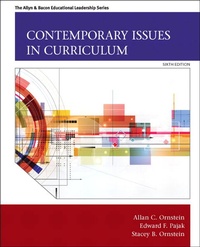
Contemporary Issues in Curriculum
Description
Contemporary Issues in Curriculum, 6/e presents an eclectic, balanced approach to the major emergent trends in the field from a diversity of leaders in the field who share their opinions and thoughts on curriculum issues. An issues-oriented collection of 36 articles by the major thinkers in curriculum study, it looks at issues that affect successful implementation, planning, and evaluation of curriculum at all levels of learning. Organized into six Parts-Curriculum and Philosophy, Curriculum and Teaching, Curriculum and Learning, Curriculum and Instruction, Curriculum and Supervision, and Curriculum and Policy-the readings reflect both traditionally held assumptions as well as those more controversial in nature. Students and practitioners have the opportunity to turn to a single source to investigate the breadth of issues that affect curriculum, examine and debate the issues, formulate their own ideas, and help shape the future direction of the field.
More details
Other editions
Previous edition
Persons
Allan C. Ornstein is a professor of education and social policy at St. John's University. He is a former Fulbright-Hayes scholar and author of 60 books. His most recent book is entitled Wealth Vs. Work: How the 1 Percent Victimize 99 Percent.
Edward Frank Pajak is a Professor in the School of Education at Johns Hopkins University. He has published more than 50 articles in prominent journals, most recently in the American Educational Research Journal (2012) and in Teachers College Record (2011), as well as six books. His current scholarship involves the application of psychoanalytic concepts toward better understanding of schools, teaching, culture, and education reform. Professor Pajak's recent books include: Contemporary Issues in Curriculum, 5th edition, Pearson (2010); Supervising Instruction: Differentiating for Teacher Success, Christopher-Gordon (2008); and Honoring Diverse Teaching Styles: A Guide for Supervisors, Association for Supervision and Curriculum Development (2003).
Stacey B. Ornstein holds a Masters in History of Education from New York University. She teaches cooking and food policy at various locations around New York City, where she lives with her husband, David, and newborn son Adrian Vir. Her writing has appeared in numerous print and online publications.
Content
- Preface
- Part One: Curriculum and Philosophy
- Chapter 1 Philosophy as A Basis for Curriculum Decisions
- Chapter 2 Goals and Objectives
- CHAPTER 3 WHAT DOES IT MEAN TO SAY A SCHOOL IS DOING WELL?
- Chapter 4 Art And Imagination: Overcoming A Desperate Stasis
- CHAPTER 5 A COMMON CORE OF READINESS, Robert Rothman
- Pro-Con Chart 1 Should the schools introduce a values-centered curriculum for all students?
- Case Study 1 A Clash Concerning the Arts Curriculum
- Part Two: Curriculum And Teaching
- Chapter 6 Teaching Themes of Care
- Chapter 7 The Heart of A Teacher
- Chapter 8 Critical Issues In Teaching
- Chapter 9 Productive Teachers: Assessing The Knowledge Base
- Chapter 10 Honoring Diverse Styles Of Beginning Teachers
- Chapter 11 Keeping Good Teachers: What It Matters, What Leaders Can Do
- Pro-Con Chart 2 Should teachers be held accountable for their teaching?
- Case Study 2 School District Proposes Evaluations by Students
- Part Three: Curriculum And Learning
- Chapter 12 Grappling
- Chapter 13 Creating Creative Minds
- Chapter 14 The Cognitive-Developmental Approach to Moral Education
- CHAPTER 15 TARGETED, NOT UNIVERSAL PRE-K
- CHAPTER 16 DEMOGRAPHICS AND EXCELLENCE IN THE 21ST CENTURY
- Chapter 17 Disciplining The Mind
- Pro-Con Chart 3 Should special education students be grouped (mainstreamed) into regular education classes?