

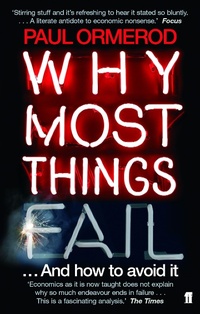
Why Most Things Fail
Published on 6. April 2006
Book
Paperback/Softback
272 pages
978-0-571-22013-7 (ISBN)
Description
From the best-selling author of The Death of Economics and Butterfly Economics, a ground-breaking look at a truth all too seldom acknowledged: most commercial and public policy ventures will not succeed.
Paul Ormerod draws upon recent advances in biology to help us understand the surprising consequences of the Iron Law of Failure. And he shows what strategies corporations, businesses and governments will need to adopt to stand a chance of prospering in a world where only one thing is certain.
Paul Ormerod draws upon recent advances in biology to help us understand the surprising consequences of the Iron Law of Failure. And he shows what strategies corporations, businesses and governments will need to adopt to stand a chance of prospering in a world where only one thing is certain.
Reviews / Votes
"'Engrossing and entertaining... A careful, comprehensible analysis of the limits of human rationality's ability to control the world.' Alasdair Palmer, Sunday Telegraph 'Gripping stuff.' Krishna Guha, Financial Times"More details
Edition
Main
Language
English
Place of publication
London
United Kingdom
Product notice
Paperback (UK-B)
Dimensions
Height: 199 mm
Width: 126 mm
Thickness: 27 mm
Weight
230 gr
ISBN-13
978-0-571-22013-7 (9780571220137)
Copyright in bibliographic data and cover images is held by Nielsen Book Services Limited or by the publishers or by their respective licensors: all rights reserved.
Schweitzer Classification
Other editions
Previous edition

Person
Paul Ormerod is the author of The Death of Economics, Butterfly Economics and Why Most Things Fail. He studied economics at Cambridge and his career has spanned the academic and practical business worlds, including working at the Economist and as a director of the Henley Centre for Forecasting. He is a Fellow of the British Academy of Social Science and has been awarded a DSchonoris causafor his contribution to economics by the University of Durham.