

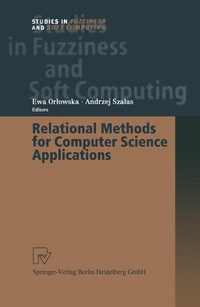
Relational Methods for Computer Science Applications
Published on 13. August 2012
Book
Paperback/Softback
XIII, 297 pages
978-3-662-00362-6 (ISBN)
Description
The origins of relational theories can be found in the work of three 19th cen- tury mathematicians: Augustus de Morgan (1864, On the syllogism IV and on the logic of relations), Charles Sanders Peirce (1882, Brief description of the algebra of relatives) and Ernst Schroder (1895, Vorlesungen iiber die Al- gebra und Logik der Relative). The modern origins of the theory of relations are due to Alfred Tarski (14 January 1902, Warsaw -26 October 1983, Berke- ley). His paper' On the calculus of Relations' published in 1941 gave rise to an algebraic theory of relations which is still extensively studied. In the 1970s, the applications of relational theories to various applied sciences emerged. Nowadays relational theories are experiencing a period of extensive development, with the emergence of new theories and systems allow- ing better understanding and better use of such theories.
Relational theories have been used, among others, in the following fields: * Theory of programs: program specification, program verification, mod- elling concurrency, process calculi, semantics of programming languages; * Databases: relational databases, tabular methods, dependency theory, rectangular and difunctional decomposition of databases; * Computational linguistics: relational semantics of natural languages, re- lational grammars, Lambek calculus; * Spatial reasoning: modelling of relationships between space regions; * Handling uncertainty: fuzzy relations, many-valued relations, information relations. Indeed, the concept of relation emerges again and again throughout computer science, from its theoretical foundations to very practical implementations.
Relational theories have been used, among others, in the following fields: * Theory of programs: program specification, program verification, mod- elling concurrency, process calculi, semantics of programming languages; * Databases: relational databases, tabular methods, dependency theory, rectangular and difunctional decomposition of databases; * Computational linguistics: relational semantics of natural languages, re- lational grammars, Lambek calculus; * Spatial reasoning: modelling of relationships between space regions; * Handling uncertainty: fuzzy relations, many-valued relations, information relations. Indeed, the concept of relation emerges again and again throughout computer science, from its theoretical foundations to very practical implementations.
More details
Series
Edition
Softcover reprint of the original 1st ed. 2001
Language
English
Place of publication
Heidelberg
Germany
Target group
Professional and scholarly
Research
Illustrations
3 s/w Abbildungen
XIII, 297 p. 3 illus.
Dimensions
Height: 235 mm
Width: 155 mm
Thickness: 17 mm
Weight
476 gr
ISBN-13
978-3-662-00362-6 (9783662003626)
DOI
10.1007/978-3-7908-1828-4
Schweitzer Classification
Other editions
Additional editions
Ewa Orlowska | Andrzej Szalas
Relational Methods for Computer Science Applications
Book
02/2001
Physica
€93.08
Article exhausted; check different version
Content
Interpretation of Tabular Expressions Using Arrays of Relations.- Translating Relational Programs into Prolog.- A Calculus for Program Contstruction Based on Fork Algebras, Design Strategies and Generic Algorithms.- Processes as Relations.- A Tableaux Procedure for the Implication Problem for Association Rules.- On a Static Verification of Integrity Constraints in Relational Databases.- Contact Relation Algebras.- Relations Old and New.- Relational Models for the Nonassociative Lambek Calculus.- Coping with Semilattices of Relations in Logics with Relative Accessibility Relations.- A Relational Formalisation of a Generic Many-Valued Modal Logic.- An Application of Standard BAO Theory to Some Abstract Information Algebras.- Proof Systems in Relation Algebra.- Connections Between Cylindric Algebras and Relation Algebras.- Lattices in Dedekind Categories.- Beyond Modalities: Sufficiency and Mixed Algebras.- Cylindric Algebras for Partial Relational Systems. Quasicylindric Algebras.