

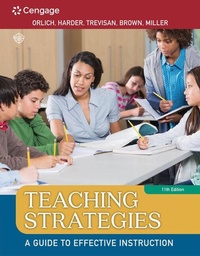
Teaching Strategies
A Guide to Effective Instruction
11th Edition
Published on 1. January 2017
Book
Paperback/Softback
416 pages
978-1-305-96078-7 (ISBN)
Description
TEACHING STRATEGIES: A GUIDE TO EFFECTIVE INSTRUCTION, now in its eleventh edition, gives you practical, applied help with commonly used classroom teaching strategies and tactics. Ideal if you are studying education or involved in a site-based teacher education program, the book focuses on topics such as lesson planning, questioning, and small-group and cooperative-learning strategies. The new edition maintains the book's solid coverage, while incorporating new and expanded material on technology integration planning, English Language Learner instruction, and proactive classroom management, as well as an up-to-date discussion of teaching students with disabilities and differentiated instruction. The text is available with the digital learning solution MindTap, which features an integrated e-portfolio, videos of classroom teaching situations, quizzes, professional resources, scenario activities, and other tools to help you succeed in the course and beyond.
More details
Edition
11th edition
Language
English
Place of publication
Belmont, CA
United States
Publishing group
Cengage Learning, Inc
Target group
College/higher education
Product notice
Paperback (trade)
Unsewn / adhesive bound
Dimensions
Height: 272 mm
Width: 213 mm
Thickness: 18 mm
Weight
794 gr
ISBN-13
978-1-305-96078-7 (9781305960787)
Copyright in bibliographic data and cover images is held by Nielsen Book Services Limited or by the publishers or by their respective licensors: all rights reserved.
Schweitzer Classification
Persons
Donald C. Orlich is Professor Emeritus with the Science Mathematics Engineering Education Center at Washington State University (WSU). He has been active in public education since 1955 and has directed numerous in-service education projects relating to the improvement of instruction. In 2001, the 160,000-member Association for Curriculum Development and Supervision honored him with its Outstanding Affiliate Article Award. In 2003, the University of Montana honored him with the Educational Leadership Excellence Award. In 2012, WSU honored him with the "Emeritus Society Excellence Award." Robert J. Harder (D.Ed.) is Professor Emeritus of Education at Washington State University. He has been active in public education since 1968 as a consultant to school districts, as director of several major in-service education projects, and as an author of monographs and articles. He has also provided leadership in the internationalization of higher education through education, research, and extension partnerships. Michael S. Trevisan (B.A. Mathematics, M.Ed. and Ph.D. Educational Psychology) is dean of the College of Education and professor of Educational Psychology at Washington State University. For the past three decades, he has provided assessment and evaluation training and technical assistance to many school districts in the Northwest. He has published widely on issues of student assessment, program evaluation, applied measurement, and large-scale testing. Abbie H. Brown (Ph.D.) is a Professor at East Carolina University teaching in the Instructional Technology program. He is an award-winning teacher and scholar, engaging in research with innovative technologies in educational settings, and documenting the trends and issues that influence the field of Instructional Design/Technology. He is an experienced classroom teacher and is co-author of a number of books, including THE ESSENTIALS OF INSTRUCTIONAL DESIGN, 3rd Edition (2016), and SECURING THE CONNECTED CLASSROOM: TECHNOLOGY PLANNING TO KEEP STUDENTS SAFE (2015). Darcy E. Miller (M.A. and Ph.D. Special Eduction) is professor of special and general education at Washington State University. She teaches assessment, research, classroom management, and inclusion courses and has served as Director of Teacher Education. Her research has been focused on special education issues and policies, including areas such as Fetal Alcohol Spectrum Disorders, technology, multicultural special education, reading, juvenile delinquency, risk/resilience, and behavior/emotional disorders in children and adolescents. She has published widely, and is the author of ENHANCING ADOLESCENT COMPETENCE: STRATEGIES FOR CLASSROOM MANAGEMENT (Wadsworth, 1998).
Content
Part I: FOUNDATIONS OF INSTRUCTIONAL DESIGN.
1. Frames of Reference for Teaching.
2. The Big Picture in Your Classroom: Focusing the Instruction Kaleidoscope.
3. Teaching Diverse Learners in Inclusive Classrooms.
Part II: FUNDAMENTAL TOOLS FOR INSTRUCTIONAL PLANNING.
4. Objectives, Taxonomies, and Standards for Instruction.
5. Mastering Instructional Planning.
6. Sequencing and Organizing Instruction.
Part III: INSTRUCTION AS A DYNAMIC PROCESS IN CLASSROOMS.
7. Classroom Assessment.
8. The Process of Classroom Questioning.
9. Small-Group Discussions and Cooperative Learning.
10. Inquiry Teaching and Higher-Level Learning.
11. Managing the Classroom.
Glossary.
Index.
1. Frames of Reference for Teaching.
2. The Big Picture in Your Classroom: Focusing the Instruction Kaleidoscope.
3. Teaching Diverse Learners in Inclusive Classrooms.
Part II: FUNDAMENTAL TOOLS FOR INSTRUCTIONAL PLANNING.
4. Objectives, Taxonomies, and Standards for Instruction.
5. Mastering Instructional Planning.
6. Sequencing and Organizing Instruction.
Part III: INSTRUCTION AS A DYNAMIC PROCESS IN CLASSROOMS.
7. Classroom Assessment.
8. The Process of Classroom Questioning.
9. Small-Group Discussions and Cooperative Learning.
10. Inquiry Teaching and Higher-Level Learning.
11. Managing the Classroom.
Glossary.
Index.