

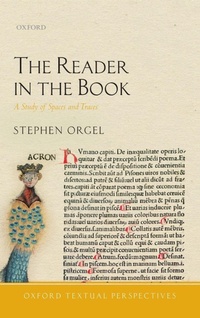
The Reader in the Book
A Study of Spaces and Traces
Published on 29. October 2015
Book
Hardback
186 pages
978-0-19-873756-8 (ISBN)
Description
The Reader in the Book is concerned with a particular aspect of the history of the book, an archeology and sociology of the use of margins and other blank spaces. One of the most commonplace aspects of old books is the fact that people wrote in them, something that, until very recently, has infuriated modern collectors and librarians. But these inscriptions constitute a significant dimension of the book's history, and what readers did to books often added to their value. Sometimes marks in books have no relation to the subject of the book, merely names, dates, prices paid; blank spaces were used for pen trials and doing sums, and flyleaves are occasionally the repository of records of various kinds. The Reader in the Book deals with that special class of books in which the text and marginalia are in intense communication with each other, in which reading constitutes an active and sometimes adversarial engagement with the book. The major examples are works that are either classics or were classics in their own time; but they are seen here as contemporaries read them, without the benefit of centuries of commentary and critical guidance. The underlying question is at what point marginalia, the legible incorporation of the work of reading into the text of the book, became a way of defacing it rather than of increasing its value-why did we want books to lose their history?
Reviews / Votes
This instructive study affords a compelling example of Stephen Orgel's archaeology of reading, whereby investigation of early inscriptions in the margins and other blank spaces of books contributes greatly to our understanding of the sociology and history of reading. * John N. King, Renaissance Quarterly * good value ... a study of early modern marginalia but also -- the bit I'm looking forward to -- a reflection on our more recent idolization of the clean, unmarked page. * Hal Jensen, Summer Books selection 2016, Times Literary Supplement * As Orgel presents his succession of case studies he shows that careful attention to how books were used can enlarge our understanding of the purposes to which earlier readers put them. * Austen Saunders, Cambridge Quarterly *More details
Series
Language
English
Place of publication
Oxford
United Kingdom
Target group
College/higher education
Illustrations
Numerous black-and-white halftones
Dimensions
Height: 235 mm
Width: 157 mm
Thickness: 15 mm
Weight
429 gr
ISBN-13
978-0-19-873756-8 (9780198737568)
Copyright in bibliographic data and cover images is held by Nielsen Book Services Limited or by the publishers or by their respective licensors: all rights reserved.
Schweitzer Classification
Other editions
Additional editions
Book
11/2017
Oxford University Press
€35.27
Shipment within 15-20 days
E-Book
10/2015
1st Edition
OUP eBook
€14.99
Available for download
Stephen Orgel
Reader in the Book: A Study of Spaces and Traces
E-Book
10/2015
1st Edition
OUP Oxford
€30.00
Available for download
Person
Stephen Orgel is the Jackson Eli Reynolds Professor in the Humanities at Stanford. He has published widely on the political and historical aspects of Renaissance literature, theater, and art history. He has taught at Harvard, Berkeley and Johns Hopkins, and has been visiting professor at universities throughout the world. In addition to his eight books, he has edited Ben Jonson's masques, Christopher Marlowe's poems and translations, the Oxford Authors John Milton, The Tempest and The Winter's Tale in The Oxford Shakespeare, and several novels by Trollope and Edith Wharton in the Oxford World's Classics. He is a general editor of the New Pelican Shakespeare.
Content
1. Reading in Action ; 2. Learning Latin ; 3. Writing for the Stage ; 4. Spenser from the Margins ; 5. Scherzo: The Insatiate Countess and the Puritan Revolution ; 6. Reading with the Countess of Pembroke and Montgomery ; 7. Coda: A Note from the Future