

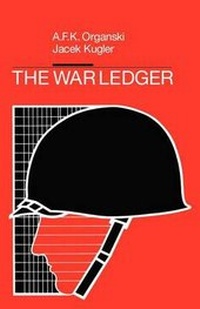
The War Ledger
Published on 15. August 1981
Book
Paperback/Softback
299 pages
978-0-226-63280-3 (ISBN)
Description
The War Ledger provides fresh, sophisticated answers to fundamental questions about major modern wars: Why do major wars begin? What accounts for victory or defeat in war? How do victory and defeat influence the recovery of the combatants? Are the rules governing conflict behavior between nations the same since the advent of the nuclear era?
The authors find such well-known theories as the balance of power and collective security systems inadequate to explain how conflict erupts in the international system. Their rigorous empirical analysis proves that the power-transition theory, hinging on economic, social, and political growth, is more accurate; it is the differential rate of growth of the two most powerful nations in the system-the dominant nation and the challenger-that destabilizes all members and precipitates world wars.
Predictions of who will win or lose a war, the authors find, depend not only on the power potential of a nation but on the capability of its political systems to mobilize its resources-the "political capacity indicator." After examining the aftermath of major conflicts, the authors identify national growth as the determining factor in a nation's recovery. With victory, national capabilities may increase or decrease; with defeat, losses can be enormous. Unexpectedly, however, in less than two decades, losers make up for their losses and all combatants find themselves where they would have been had no war occurred.
Finally, the authors address the question of nuclear arsenals. They find that these arsenals do not make the difference that is usually assumed. Nuclear weapons have not changed the structure of power on which international politics rests. Nor does the behavior of participants in nuclear confrontation meet the expectations set out in deterrence theory.
The authors find such well-known theories as the balance of power and collective security systems inadequate to explain how conflict erupts in the international system. Their rigorous empirical analysis proves that the power-transition theory, hinging on economic, social, and political growth, is more accurate; it is the differential rate of growth of the two most powerful nations in the system-the dominant nation and the challenger-that destabilizes all members and precipitates world wars.
Predictions of who will win or lose a war, the authors find, depend not only on the power potential of a nation but on the capability of its political systems to mobilize its resources-the "political capacity indicator." After examining the aftermath of major conflicts, the authors identify national growth as the determining factor in a nation's recovery. With victory, national capabilities may increase or decrease; with defeat, losses can be enormous. Unexpectedly, however, in less than two decades, losers make up for their losses and all combatants find themselves where they would have been had no war occurred.
Finally, the authors address the question of nuclear arsenals. They find that these arsenals do not make the difference that is usually assumed. Nuclear weapons have not changed the structure of power on which international politics rests. Nor does the behavior of participants in nuclear confrontation meet the expectations set out in deterrence theory.
More details
Language
English
Place of publication
Chicago
United States
Publishing group
The University of Chicago Press
Target group
College/higher education
Professional and scholarly
Dimensions
Height: 22 mm
Width: 14 mm
Thickness: 2 mm
Weight
397 gr
ISBN-13
978-0-226-63280-3 (9780226632803)
Copyright in bibliographic data and cover images is held by Nielsen Book Services Limited or by the publishers or by their respective licensors: all rights reserved.
Schweitzer Classification
Other editions
Additional editions
A. F. K. Organski | Jacek Kugler
The War Ledger
E-Book
05/2024
1st Edition
University of Chicago Press
from
€32.40
Available for download