

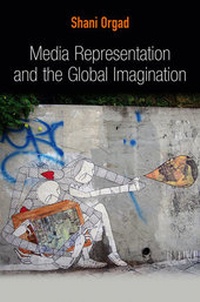
Media Representation and the Global Imagination
Published on 7. September 2012
Book
Hardback
296 pages
978-0-7456-4379-3 (ISBN)
Description
This book is a clear, systematic, original and lively account of how media representations shape the way we see our and others' lives in a global age. It provides in-depth analysis of a range of international media representations of disaster, war, conflict, migration and celebration.
The book explores how images, stories and voices, on television, the Internet, and in advertisements and newspapers, invite us to relocate to distant contexts, and to relate to people who are remote from our daily lives, by developing 'mediated intimacy' and focusing on the self. It also explores how these representations shape our self-narratives.
Orgad examines five sites of media representation - the other, the nation, possible lives, the world and the self. She argues that representations can and should contribute to fostering more ambivalence and complexity in how we think and feel about the world, our place in it and our relation to far-away others.
Media Representations and the Global Imagination will be of particular interest to students and scholars of media and cultural studies, as well as sociology, politics, international relations, development studies and migration studies.
Reviews / Votes
'This valuable book connects the scholarship on the social power of the imagination with the hitherto separate literature on new media technologies, audience formation and global mediation. In doing so it enriches both these fields while building some new bridges between them. It will be widely appreciated by anthropologists, media scholars and students of the cultural dynamics of globalization.' Arjun Appadurai, New York University 'Shani Orgad has written a readable, theoretically sophisticated book about media representation in a global world. By showing the complexity and ambiguity of texts and interpretation, she deftly avoids the twin problems of absolute domination and complete resistance that have characterized the literature. Based on a smart selection of cases, she carefully dissects the struggles over imagining a global world. Highly recommended to anyone interested in state-of-the-art analysis about media resources used to envision what "global" means.' Silvio Waisbord, George Washington University "This book will be of interest in a number of ways to those studying media in a global context." Internal Journal of Communication 'We live in a global and media age, a time when how we imagine the world is and could yet be, can, potentially and actually, enter into the course and conduct of that same world. Shani Orgad illuminates and intelligently reflects on this most crucial and consequential interplay between media representation and global imagination. A book for our times.' Simon Cottle, Cardiff University "Although this book will appeal directly to international media specialists, scholars broadly interested in globalization could use it in the classroom and their research." H-Net ReviewsMore details
Series
Edition
1. Auflage
Language
English
Place of publication
Oxford
United Kingdom
Publishing group
John Wiley and Sons Ltd
Target group
Professional and scholarly
Product notice
sewn/stitched
Cloth over boards
Dimensions
Height: 231 mm
Width: 155 mm
Thickness: 25 mm
Weight
476 gr
ISBN-13
978-0-7456-4379-3 (9780745643793)
Schweitzer Classification
Other editions
Additional editions
Shani Orgad
Media Representation and the Global Imagination
E-Book
03/2014
Polity Press
€18.99
Available for download
Shani Orgad
Media Representation and the Global Imagination
Book
09/2012
Polity Press
€27.50
Shipment within 15-20 days
Person
Shani Orgad is Senior Lecturer in the Department of Media and Communications at the London School of Economics and Political Science.
Content
Detailed Table of Contents
List of Illustrations
Preface
Acknowledgements
Introduction
1 Media representation and the global imagination: A framework
2 Imagining others: Representations of natural disasters
3 Imagining ourselves: Representations of the nation
4 Imagining possible lives: Representations of migration
5 Imagining the world: Representations of New Year celebrations
6 Imagining the self
7 Conclusion: Nothing gets you closer revisited
Bibliography
Notes