

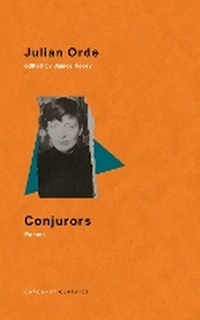
Conjurors
Poems
Published on 26. September 2024
Book
Paperback/Softback
180 pages
978-1-80017-455-9 (ISBN)
Description
A Telegraph Book of the Year 2024
In Conjurors, a major poet is revealed for the first time. Julian Orde (1917-74) published only in magazines during her lifetime. A friend of Stevie Smith and an intimate of Dylan Thomas and W.S. Graham, she was one of those 'peripheral figures' who turns out to be a centre in her own right. Her evolving worlds and changing landscapes as a writer come alive in these substantial, unexpected poems. Her lyrical surrealism is prophetic and retains its charge:
The speckled water rippled into minnows,
Of worms and turf smelt all the fish pale morning,
Earth pushed up its smell of worms through grass and wet,
Through sodden leaf, mushroom and winking frog.
I, on the bank, lived quick as breathing frog,
Its lungs and mine puffed out September's thin
Morning, sallow and silver, fish-filled, the sky in a river.
Wherever I go in the guilty years there still
Goes my innocence with me [...]
William Empson celebrated her. 'Wonder at nature, wonder at all experience, is her note, and she gets a great deal of variety into it; also she has a beautiful ear, and a supply of unforced humour.'
The editor of PN Review said, 'It's hard to imagine the middle of the twentieth century now without Julian Orde.' Carcanet's recovery of her work - thanks to the patient archaelogy of James Keery and V. Beatson - proves that the past, even the relatively recent past, is at least as rich in resource and surprise as the present.
In Conjurors, a major poet is revealed for the first time. Julian Orde (1917-74) published only in magazines during her lifetime. A friend of Stevie Smith and an intimate of Dylan Thomas and W.S. Graham, she was one of those 'peripheral figures' who turns out to be a centre in her own right. Her evolving worlds and changing landscapes as a writer come alive in these substantial, unexpected poems. Her lyrical surrealism is prophetic and retains its charge:
The speckled water rippled into minnows,
Of worms and turf smelt all the fish pale morning,
Earth pushed up its smell of worms through grass and wet,
Through sodden leaf, mushroom and winking frog.
I, on the bank, lived quick as breathing frog,
Its lungs and mine puffed out September's thin
Morning, sallow and silver, fish-filled, the sky in a river.
Wherever I go in the guilty years there still
Goes my innocence with me [...]
William Empson celebrated her. 'Wonder at nature, wonder at all experience, is her note, and she gets a great deal of variety into it; also she has a beautiful ear, and a supply of unforced humour.'
The editor of PN Review said, 'It's hard to imagine the middle of the twentieth century now without Julian Orde.' Carcanet's recovery of her work - thanks to the patient archaelogy of James Keery and V. Beatson - proves that the past, even the relatively recent past, is at least as rich in resource and surprise as the present.
Reviews / Votes
'What emerges from these poems is a poet who was immensely technically gifted and who had absorbed the influences of Dylan Thomas and Graham in his Apocalyptic phase. Orde clearly used those influences and her own feeling for surrealism to create poems which always feel necessary and are couched in a personal voice which is there from the beginning.'Ian Pople, The High Window
More details
Language
English
Place of publication
United Kingdom
Publishing group
Carcanet Press Ltd
Dimensions
Height: 135 mm
Width: 215 mm
Thickness: 16 mm
Weight
212 gr
ISBN-13
978-1-80017-455-9 (9781800174559)
Copyright in bibliographic data and cover images is held by Nielsen Book Services Limited or by the publishers or by their respective licensors: all rights reserved.
Schweitzer Classification
Other editions
Additional editions
E-Book
09/2024
Carcanet Classics
€14.39
Available for download
Persons
Julian Orde (1917-74) was a granddaughter of the 4th Duke of Wellington, raised in London and Paris, and presented at court as a debutante. She rebelled. She achieved distinction and professional success as a poet, a writer of short stories, an actor, a playwright, a screenwriter and a copywriter. She published around twenty poems in the forties, but no more in her lifetime. Greville Press published a pamphlet edition of her classic long poem, Conjurors, in 1988.
James Keery lives in Culcheth with his wife Julie and teaches English in Wigan. He has published a collection of poems, That Stranger, The Blues, and edited Carcanet's Apocalypse, an anthology of mid-century visionary modernist poetry, as well as the Collected Poems of the Scottish poet Burns Singer.
James Keery lives in Culcheth with his wife Julie and teaches English in Wigan. He has published a collection of poems, That Stranger, The Blues, and edited Carcanet's Apocalypse, an anthology of mid-century visionary modernist poetry, as well as the Collected Poems of the Scottish poet Burns Singer.