

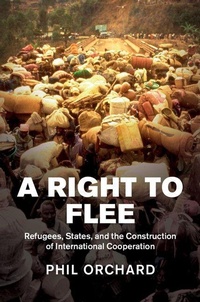
A Right to Flee
Refugees, States, and the Construction of International Cooperation
Published on 9. October 2014
Book
Hardback
310 pages
978-1-107-07625-9 (ISBN)
Description
Why do states protect refugees? In the past twenty years, states have sought to limit access to asylum by increasing their border controls and introducing extraterritorial controls. Yet no state has sought to exit the 1951 Refugee Convention or the broader international refugee regime. This book argues that such international policy shifts represent an ongoing process whereby refugee protection is shaped and redefined by states and other actors. Since the seventeenth century, a mix of collective interests and basic normative understandings held by states created a space for refugees to be separate from other migrants. However, ongoing crisis events undermine these understandings and provide opportunities to reshape how refugees are understood, how they should be protected, and whether protection is a state or multilateral responsibility. Drawing on extensive archival and secondary materials, Phil Orchard examines the interplay among governments, individuals, and international organizations that has shaped how refugees are understood today.
Reviews / Votes
'An outstanding contribution to both refugee studies and international relations, A Right to Flee masterfully unpacks the deeper historical structures that explain how patterns of international cooperation endure and adapt.' Alexander Betts, University of Oxford 'In this book, Phil Orchard establishes himself as one of the leading international relations scholars writing about the evolution of international refugee policy.' Gil Loescher, University of Oxford '... a timely and much-needed attempt to trace the development of the concept of international refugee protection from its very early origins in the seventeenth century to the present ... A Right to Flee will be of great interest to refugee and forced migration scholars, scholars of international organizations, and more generally to anyone interested in the birth and endurance of the modern state.' Rebecca Hamlin, International Studies Review 'A Right to Flee: Refugees, States, and the Construction of International Cooperation is an exceptionally coherent historical analysis and a must-read for anyone researching in the fields of refugee and political theory, as well as for those with a broader interest in researching migration frameworks.' Julia Muraszkiewicz, International Journal of Refugee LawMore details
Language
English
Place of publication
Cambridge
United Kingdom
Target group
Professional and scholarly
Product notice
sewn/stitched
Cloth over boards
Illustrations
6 Tables, black and white; 11 Line drawings, black and white
Dimensions
Height: 231 mm
Width: 157 mm
Thickness: 28 mm
Weight
567 gr
ISBN-13
978-1-107-07625-9 (9781107076259)
Copyright in bibliographic data and cover images is held by Nielsen Book Services Limited or by the publishers or by their respective licensors: all rights reserved.
Schweitzer Classification
Other editions
Additional editions
Book
06/2016
Cambridge University Press
€46.40
Shipment within 15-20 days
E-Book
10/2014
Cambridge University Press
€21.99
Available for download
E-Book
09/2014
1st Edition
Cambridge University Press
€24.99
Available for download
Person
Phil Orchard is a Lecturer in International Relations and Peace and Conflict Studies at the University of Queensland and a Research Associate with the Asia-Pacific Centre for the Responsibility to Protect. He holds a PhD from the University of British Columbia, and previously worked as the Assistant to the Representative of the UN Secretary-General for Internally Displaced Persons. His research focuses on international efforts to provide institutional and legal forms of protection to civilians and forced migrants, and his work has been published in Global Governance, International Affairs, and the Review of International Studies.
Content
1. Introduction: a right to flee; 2. Structures, agency, and refugee protection; 3. Refugees and the emergence of international society; 4. The nineteenth century: a laissez-faire regime; 5. The interwar refugee regime and the failure of international cooperation; 6. American leadership and the emergence of the postwar regime; 7. The norm entrepreneurship of the United Nations High Commissioner for Refugees; 8. The non-entree regime; 9. Refugees and state cooperation in international society.