

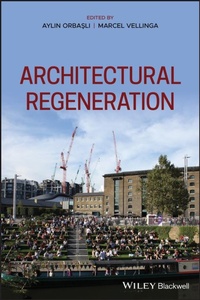
Architectural Regeneration
1st Edition
Published on 13. August 2020
Book
Hardback
288 pages
978-1-119-34033-1 (ISBN)
Description
Architectural Regeneration will address the different perspectives, scales and tools of architectural regeneration by means of detailed overviews of the current state of thinking and practice, with case studies from around the world used as examples to support the theoretical arguments.
More details
Other editions
Additional editions
Aylin Orbasli | Marcel Vellinga
Architectural Regeneration
E-Book
08/2020
1st Edition
Wiley-ISTE
€70.99
Available for download
Aylin Orbasli | Marcel Vellinga
Architectural Regeneration
E-Book
07/2020
1st Edition
Wiley-ISTE
€70.99
Available for download
Persons
Dr Aylin Orbasli is an architect by training and has specialised in building and area conservation. She has 15 years teaching experience in the field defined as 'architectural regeneration' and the conservation of the historic environment. She has also been practicing building conservation for over 20 years, and through her practice has worked on numerous urban and rural regeneration projects in the UK and internationally (www.aylinorbasli.com). Her teaching and practice are supported by research and she has published extensively on the subject.
Dr Marcel Vellinga is Reader in Anthropology of Architecture and Director of the Place, Culture and Identity research group in the School of Architecture, Oxford Brookes University. Holding a PhD in Cultural Anthropology from Leiden University, his teaching and research are concerned with the anthropological study of architecture, vernacular architecture and architectural regeneration. Marcel is a Director of the Paul Oliver Vernacular Architecture Library.
For the past nine years the editors have jointly run the MA International Architectural Regeneration and Development at Oxford Brookes University.
Content
Introduction
Aylin Orbasli & Marcel Vellinga
Theory
Context
Design
Acknowledgements
Bibliography
PART I: THEORY
1 Architectural regeneration in its theoretical context
Aylin Orbasli & Marcel Vellinga
Introduction
Theoretical context
Processes of transformation
Architecture as a dynamic process
Conservation theory
Defining a continuum: re-merging conservation and design in architecture
Architecture as a transformative tool
Architectural (design) theory
Regeneration theories
Theories of place identity and authenticity
Speeding up and time theories
The principles that shape architectural regeneration
Architecture is a cultural process
Context/environment matters
Adaptive capacity and robustness
The art of adding and subtracting
Contextual complexity and interconnectedness
Design adds value
Conclusion
Further Reading
Bibliography
2 Making the case for architectural regeneration
Aylin Orbasli
Introduction
Heritage-led regeneration
Economic benefits and cycles of architectural regeneration
Environmental benefits of architectural regeneration
Intangible and social benefits of architectural regeneration
Conclusion
Further Reading
Bibliography
3 Decision making in regeneration practice
Juliet Carpenter
Introduction
Urban regeneration governance within a theoretical context
Evolution of decision-making for urban regeneration
Public vs private-led regeneration
Community engagement in regeneration
Post-2008 regeneration
Conclusion
Further reading
Bibliography
4 Creativity, newcomers and the transformation of inner cityscapes
Steve Shaw
Introduction
Conceptual framework: re-constructing 'creativity', space and place
The long view: polity, policy and practice in the uk
Street-level developments: new hotspots for creativity and growth?
Conclusion
Further reading
Bibliography
Case study 1: Architectural regeneration in Oxford, UK
Geoffrey Randell
Introduction
Regeneration and industry
Regeneration of oxford castle and prison
Reflections
Acknowledgements
Bibliography
PART II: CONTEXT
5 Urban regeneration
Aylin Orbasli
Introduction
The context of urban conservation
What's in a name?
The urban conservation movement: a brief history
Urban conservation in the planning context
Urban conservation in practice
Hip Neighbourhoods and Gentrification
Historic places as tourism destinations
Flagship projects and branded quarters
Industrial areas
Reimaging and reimagining historic urban quarters
Making urban conservation work
Conclusion
Further reading
Bibliography
6 Suburban regeneration
Denise Lawrence
Introduction
Gentrifying bungalow neighbourhoods
Mansionising the modern suburb
Regenerating suburban communities with immigrants
Conclusion
Further reading
Bibliography
7 Rural regeneration
Marcel Vellinga & Sanja Loncar
Introduction
Conceptualising rurality
Rural realities
Architecture in rural areas
Architectural regeneration and counter-urbanisation
Architectural regeneration in abandoned rural areas
Architectural regeneration in protected areas
Architectural regeneration as part of thematic routes
Conclusion
Further reading
Bibliography
8 Temporariness in architectural regeneration
Aylin Orbasli & Joanna Karmowska
Introduction
The notion of temporariness and organisational temporariness
Defining 'temporary' in the urban context
Key players and drivers
The role of temporary interventions in regeneration
Longer term impacts and unintended consequences
Conclusion
Further readings
Bibliography
9 Unfinished buildings
Igea Troiani & Andrew Dawson
Introduction: Unfinished Buildings in an Age of Uncertainty
Research on Unfinished Buildings: From Venezuela to Italy, to Greece and beyond
The Evolution of Concrete Frame Construction: From Maison Domino to Polykatoikia
Design tactics for 'Unfinished Athens'
Sustainable design for Unfinished buildings
The Temporary Design of Unfinished Buildings
The Socio-cultural Engagement of Unfinished Buildings
Ethical Design Practice for Unfinished Buildings
Socio-political, Activist Critique of Unfinished Buildings
Conclusion: Reflections on Unfinished Athens and Architecture's relationship with Capitalism
Acknowledgements
Bibliography
Case study 2: Architectural regeneration in Istanbul, Turkey
Deniz Ikiz-Kaya
Introduction
Regeneration approaches and practices in istanbul
Planning and regulatory systems
Culture-led regeneration in the post-industrial waterfronts
Tourism-led regeneration in historic residential areas
Reconstruction as a tool of regeneration
Conclusion
Bibliography
PART III: DESIGN
10 Adaptive reuse as a design process
Jonathan Bassindale
Introduction
The research-based approach
Evidential Value
Historical Value
Aesthetic Value
Communal Value
Building recording and baseline information
Feasibility
Design interventions
Summary and conclusions
Further reading
Bibliography
11 Sustainability in architectural regeneration
Paola Sassi
Introduction
Sustainability and the built environment - a framework for architectural regeneration
Regeneration: challenges and opportunities for sustainable solutions
Synergistic Aims of Regeneration and Sustainability
Compatible Aims of Regeneration and Sustainability
Conflicting and Challenging Aims of Regeneration and Sustainability
Heritage versus sustainable building operation
Conclusion
Acknowledgements
Further reading
Bibliography
12 Architectural regeneration practice in different contexts
Julia Wedel
Introduction
'The best of all worlds': heritage regeneration in international development
Accessing work in heritage conservation and international development
Garnering local support: negotiating the interface between regeneration and development
Project funding, community gains and collaborative working
Shaping mentalities towards a shared sense of ownership
Decision-making between conservation, repair and replacement
Creative reuse in architectural practice
Lessons from engaging with local communities
The architect as brief writer
Improving environmental performance in existing building: Redefining achievable and desirable
The future of financing architectural regeneration
Regeneration practice in a london local authority
Balancing competing needs across the scales of area regeneration
Addressing housing challenges within multiple constraints
Making space for conservation in local authority regeneration
Opportunities and priorities for creative regeneration practice in municipal settings
Regeneration practice as citizenship: negotiating social histories in times of transition and crisis
Client relationships as advocacy for dialogue and participation
Shaping policy to protect cultural heritage in times of socio-political transition
Architectural intervention in existing contexts
Conclusions
Acknowledgements
Bibliography
13 Design in context
Matt Gaskin
Introduction
Method
Context
Working with layers
Articulation and layering
Facadism
Wider context and education
In conclusion
Further reading
Bibliography
Case study 3: Architectural regeneration through public education in Portugal
Sofia Aleixo
Introduction
The significance of public historic schools
The heritage values of liceus
Safeguarding Portuguese liceus
The adaptive reuse context
Challenges encountered in managing change
The assessment of heritage significance
Adaptive reuse design principles and strategies
Conclusion
Acknowledgments
Bibliography
14 Teaching architectural regeneration
Aylin Orbasli, Marcel Vellinga, Julia Wedel and Geoffrey Randell
Introduction
Approach and framework
The value of research
Case study box: Case study: Design-led research in Agra, India
Being realistic
Case study box: Case study: Rural regeneration and vernacular architecture
Resource sensitivity
Case study box: Case study: Industrial heritage in Europe
Programme management
Fitting it all in
Case study box: Case study: Practicing temporary regeneration
Practices of engagement
Case study box: Case study: Community engagement in Ras Al Khaimah, UAE
Achieving impact through education
Conclusion
Acknowledgements
Bibliography