

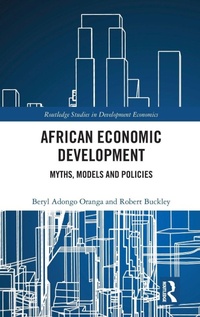
African Economic Development
Myths, Models and Policies
1st Edition
Will be published approx. on 11. December 2025
Book
Hardback
134 pages
978-1-032-97910-6 (ISBN)
Description
Myths have long plagued the understanding of Africa. Today, the myths continue but are very different and certainly are more sophisticated, taking the form of economic models of behavior or statistical analyses, sometimes based on faulty data or interpretations of it. It is not surprising, as a result, that they lead to very different policy conclusions.
This book reviews the performance of low-income African countries and highlights the challenges posed by measurement and methodological problems. It also discusses some of the more significant myths that have arisen, as well as the way that economic models - which themselves are also myths - if carefully structured, can often be useful for understanding, if not carefully describing, the situation of many low-income African countries. Structured in three parts, the book first critiques historical and narrative-driven myths, then investigates model-based myths around convergence and growth; and the final section synthesizes eight dominant myths that continue to shape policy. The book addresses key themes such as poverty traps, economic growth, and urbanization, providing an examination of the complexities surrounding these issues in low-income African countries. It brings together current development issues in one place in a way that builds upon new and improved data sources. Insights from various fields are integrated into the book, providing a holistic understanding of the development landscape in low-income Africa.
This book will appeal to academics, researchers, and advanced students, as well as policymakers and development practitioners, concerned with poverty and development issues, especially in Africa.
This book reviews the performance of low-income African countries and highlights the challenges posed by measurement and methodological problems. It also discusses some of the more significant myths that have arisen, as well as the way that economic models - which themselves are also myths - if carefully structured, can often be useful for understanding, if not carefully describing, the situation of many low-income African countries. Structured in three parts, the book first critiques historical and narrative-driven myths, then investigates model-based myths around convergence and growth; and the final section synthesizes eight dominant myths that continue to shape policy. The book addresses key themes such as poverty traps, economic growth, and urbanization, providing an examination of the complexities surrounding these issues in low-income African countries. It brings together current development issues in one place in a way that builds upon new and improved data sources. Insights from various fields are integrated into the book, providing a holistic understanding of the development landscape in low-income Africa.
This book will appeal to academics, researchers, and advanced students, as well as policymakers and development practitioners, concerned with poverty and development issues, especially in Africa.
More details
Series
Language
English
Place of publication
London
United Kingdom
Publishing group
Taylor & Francis Ltd
Target group
College/higher education
Postgraduate
Illustrations
5 s/w Tabellen, 1 s/w Photographie bzw. Rasterbild, 9 s/w Abbildungen, 8 s/w Zeichnungen
5 Tables, black and white; 8 Line drawings, black and white; 1 Halftones, black and white; 9 Illustrations, black and white
Dimensions
Height: 240 mm
Width: 161 mm
Thickness: 13 mm
Weight
396 gr
ISBN-13
978-1-032-97910-6 (9781032979106)
Copyright in bibliographic data and cover images is held by Nielsen Book Services Limited or by the publishers or by their respective licensors: all rights reserved.
Schweitzer Classification
Other editions
Additional editions
E-Book
12/2025
Routledge
€60.49
Available for download
E-Book
12/2025
Routledge
€60.49
Available for download
Persons
Beryl Adongo Oranga, PhD, is a Senior Research Economist based in the USA, whose work focuses on Sub-Saharan Africa.
Robert Buckley, PhD, was the Studley Fellow in International Affairs at the New School, USA, and Advisor and Principal Economist at the World Bank.
Robert Buckley, PhD, was the Studley Fellow in International Affairs at the New School, USA, and Advisor and Principal Economist at the World Bank.
Content
Preface.1. Introduction Section I: Perspectives in Search of Theory 2. Economic Growth in Low-Income Africa: Through the Prism of Improved and More Recent Data 3. Foreign Aid: Finance Versus Fiscal Assistance 4. Africa is not On Time Section II: Theory in Search of Evidence 5. Convergence: Not in Low-Income Africa 6. Obstacles to Convergence: Thought Experiments and Divergence Clubs 7. The Bottom Half of the Bottom Billion: Changes Over Time Section III: Conclusion 8. Myths and their Implications