

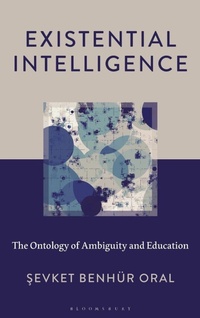
Existential Intelligence
The Ontology of Ambiguity and Education
Will be published approx. on 16. April 2026
Book
Hardback
336 pages
978-1-6669-7169-9 (ISBN)
Description
This book develops an ontological approach to understanding existential intelligence and its connections to democracy and education.
Sevket Benhuer Oral examines the concept of existential intelligence-hereafter ExistI-on an ontological level. ExistI is not conceived as a psychological aptitude that one can be good at or not like spatial or bodily-kinesthetic intelligence. Rather, it refers to a unitary experience that is riddled with ambiguity. All human beings are potentially open to such experience since we all have the capacity to experience the extraordinary, or better put, the extraordinariness of the ordinary. Although Howard Gardner later identified existential intelligence among other intelligences, his theory of multiple intelligences, while still widely accepted by educators, did not adequately explore this concept, especially in its political, moral, and philosophical dimensions. It is essential that we do since ExistI is ultimately about our capacity for more peaceful ways of co-existing with others, the extraordinariness of living collectively with human and nonhuman beings.
Sevket Benhuer Oral examines the concept of existential intelligence-hereafter ExistI-on an ontological level. ExistI is not conceived as a psychological aptitude that one can be good at or not like spatial or bodily-kinesthetic intelligence. Rather, it refers to a unitary experience that is riddled with ambiguity. All human beings are potentially open to such experience since we all have the capacity to experience the extraordinary, or better put, the extraordinariness of the ordinary. Although Howard Gardner later identified existential intelligence among other intelligences, his theory of multiple intelligences, while still widely accepted by educators, did not adequately explore this concept, especially in its political, moral, and philosophical dimensions. It is essential that we do since ExistI is ultimately about our capacity for more peaceful ways of co-existing with others, the extraordinariness of living collectively with human and nonhuman beings.
More details
Language
English
Place of publication
United States
Publishing group
Bloomsbury Publishing Plc
Target group
College/higher education
Dimensions
Height: 235 mm
Width: 157 mm
Thickness: 22 mm
Weight
633 gr
ISBN-13
978-1-6669-7169-9 (9781666971699)
Copyright in bibliographic data and cover images is held by Nielsen Book Services Limited or by the publishers or by their respective licensors: all rights reserved.
Schweitzer Classification
Other editions
Additional editions
E-Book
02/2026
1st Edition
Bloomsbury Academic
€94.99
Available for download
E-Book
02/2026
1st Edition
Bloomsbury Academic
€94.99
Available for download
Person
Sevket Benhuer Oral is Senior Researcher at the Vytautas Kavolis Research Institute, Vytautas Magnus University, Lithuania.
Content
List of Tables
Preface
Acknowledgements
Introduction
Part One: Orientations
1. Wittgenstein's Duck-Rabbit
2. Implaced within Social-Historical Worlds
3. Orientation towards the Absolute
Part Two: Exfoliations
4. The Limited Adoption of Modern Philosophical Insights
5. A Condensed Synopsis of a Philosophical Tradition: Reflections on the Unconscious
6. Plurality of Being, of Language, and of Sociality
7. Ontological Ambiguity in the Context of Existential Intelligence
8. What Does the Near-Absence of Existential Intelligence Look Like?
9. Northern Exposure: "What is So Wonderful about Being Big?"
10. Beyond Instrumentalism: Rethinking Wisdom and Existential Intelligence in Psychological Research
11. An Existential Conversation with ChatGPT-4o(mni)
12. Educational Matters: Can Existential Intelligence be Reduced to Criticality?
Conclusion: Existential Intelligence and Liberal Democracy
References
About the Author
Index
Preface
Acknowledgements
Introduction
Part One: Orientations
1. Wittgenstein's Duck-Rabbit
2. Implaced within Social-Historical Worlds
3. Orientation towards the Absolute
Part Two: Exfoliations
4. The Limited Adoption of Modern Philosophical Insights
5. A Condensed Synopsis of a Philosophical Tradition: Reflections on the Unconscious
6. Plurality of Being, of Language, and of Sociality
7. Ontological Ambiguity in the Context of Existential Intelligence
8. What Does the Near-Absence of Existential Intelligence Look Like?
9. Northern Exposure: "What is So Wonderful about Being Big?"
10. Beyond Instrumentalism: Rethinking Wisdom and Existential Intelligence in Psychological Research
11. An Existential Conversation with ChatGPT-4o(mni)
12. Educational Matters: Can Existential Intelligence be Reduced to Criticality?
Conclusion: Existential Intelligence and Liberal Democracy
References
About the Author
Index