

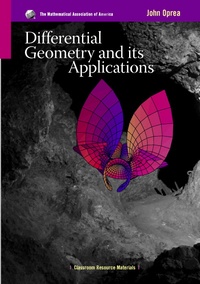
Differential Geometry and its Applications
Published on 6. September 2007
Book
Hardback
487 pages
978-0-88385-748-9 (ISBN)
Description
Differential geometry has a long, wonderful history and has found relevance in many areas. This book studies the differential geometry of surfaces with the goal of helping students make the transition from the standard university curriculum to a type of mathematics that is a unified whole, by mixing geometry, calculus, linear algebra, differential equations, complex variables, the calculus of variations, and notions from the sciences. Differential geometry is not just for mathematics majors, but also for students in engineering and the sciences. Into the mix of these ideas comes the opportunity to visualize concepts through the use of computer algebra systems such as Maple. The book emphasizes that this visualization goes hand-in-hand with the understanding of the mathematics behind the computer construction. The book is rich in results and exercises that form a continuous spectrum, from those that depend on calculation to proofs that are quite abstract.
Reviews / Votes
... There is a good deal to like about this book: the writing is lucid, drawings and diagrams are plentiful and carefully done, and the author conveys a contagious sense of enthusiasm for his subject."" - William J. Satzer, MAA ReviewsMore details
Series
Language
English
Place of publication
Washington
United States
Target group
College/higher education
Dimensions
Height: 261 mm
Width: 182 mm
Thickness: 34 mm
Weight
1170 gr
ISBN-13
978-0-88385-748-9 (9780883857489)
Copyright in bibliographic data and cover images is held by Nielsen Book Services Limited or by the publishers or by their respective licensors: all rights reserved.
Schweitzer Classification
Person
John Oprea is a Professor of mathematics at Cleveland State University in Ohio and a Lester R. Ford award recipient
Content
Preface; The Point of this Book; Projects; Prerequisites; Book Features; Elliptic Functions and Maple Note; Thanks; For Users of Previous Editions; Maple 8 to 9; Note to students; 1. The geometry of curves; 2. Surfaces; 3. Curvatures; 4. Constant mean curvature surfaces; 5. Geodesics, metrics and isometries; 6. Holonomy and the Gauss-Bonnet theorem; 7. The calculus of variations and geometry; 8. A glimpse at higher dimensions; Appendix A. List of examples; Appendix B. Hints and solutions to selected problems.