

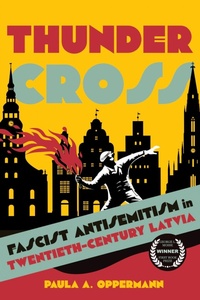
Thunder Cross
Fascist Antisemitism in Twentieth-Century Latvia
Will be published approx. on 21. October 2025
Book
Hardback
280 pages
978-0-299-35310-0 (ISBN)
Description
Founded in 1932, the Perkonkrusts ("Thunder Cross") was the largest and most prominent right-wing political party in Latvia in the early twentieth century. Its motto-"Latvia for Latvians!"-echoed the ultranationalist rhetoric of similar movements throughout Europe at the time. Unlike the Nazis in Germany or the Fascists in Italy, however, the Perkonkrusts never succeeded in seizing power. Nevertheless, Holocaust historian Paula A. Oppermann argues, its movement left an indelible mark on the country. The antisemitism at the core of the Perkonkrusts' ideology remained a driving force for Latvian fascists throughout the twentieth century, persisting despite shifting historical and political contexts.
Thunder Cross is the most comprehensive study of Latvia's fascist movement in English to date, and the only work that investigates the often neglected continuities of fascist antisemitism after World War II. Formulated as an empirical case study, this book draws on international and interdisciplinary secondary literature and sources in seven languages to broaden our understanding of fascism, antisemitism, and mass violence from Germany and Italy to the larger European context.
Thunder Cross is the most comprehensive study of Latvia's fascist movement in English to date, and the only work that investigates the often neglected continuities of fascist antisemitism after World War II. Formulated as an empirical case study, this book draws on international and interdisciplinary secondary literature and sources in seven languages to broaden our understanding of fascism, antisemitism, and mass violence from Germany and Italy to the larger European context.
Reviews / Votes
"This is an impressive, extensively researched manuscript on a little-known European fascist movement. With a close eye to people and place, it places the unique history of this movement in the tumultuous context of war, revolution, and the emergence of the radical right in Latvia and interwar Europe." - Molly Pucci, author of Security Empire: The Secret Police in Communist Eastern Europe"Finally, a reliable and meticulously researched study of antisemitism and fascism in Latvia before, during, and after World War II. This book shows that one group of Latvians developed their own forms of fascist movements appropriate to local conditions and eagerly participated in the Holocaust as it gave them the opportunity to carry out their long-desired goal of annihilating the Jews." - Roland Clark, University of Liverpool
More details
Series
Language
English
Place of publication
Wisconsin
United States
Target group
College/higher education
Illustrations
16 b&w illus., 2 maps, 4 tables
Dimensions
Height: 229 mm
Width: 152 mm
Weight
454 gr
ISBN-13
978-0-299-35310-0 (9780299353100)
Copyright in bibliographic data and cover images is held by Nielsen Book Services Limited or by the publishers or by their respective licensors: all rights reserved.
Schweitzer Classification
Person
Paula A. Oppermann is a researcher at the Historische Kommission zu Berlin. Her work has appeared in S:I.M.O.N. (Shoah: Intervention. Methods. Documentation), Peripheral Histories, Quest. Issues in Contemporary Jewish History, and elsewhere.
Content
List of Illustrations
Acknowledgments
List of Abbreviations
Introduction
Chapter 1. Roots of VOElkisch Antisemitism in the Nineteenth and Early Twentieth Centuries
Chapter 2. Fascists in Full Swing
Chapter 3. Fascists Under Pressure
Chapter 4. Opponents and Supporters
Chapter 5. International Fascism-a Logical Consequence
Chapter 6. World War II and the Postwar Period
Conclusion
Notes
Bibliography
Index
Acknowledgments
List of Abbreviations
Introduction
Chapter 1. Roots of VOElkisch Antisemitism in the Nineteenth and Early Twentieth Centuries
Chapter 2. Fascists in Full Swing
Chapter 3. Fascists Under Pressure
Chapter 4. Opponents and Supporters
Chapter 5. International Fascism-a Logical Consequence
Chapter 6. World War II and the Postwar Period
Conclusion
Notes
Bibliography
Index