

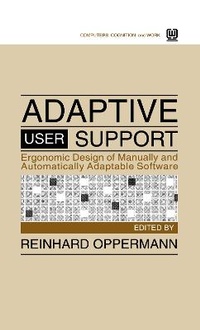
Adaptive User Support
Ergonomic Design of Manually and Automatically Adaptable Software
1st Edition
Published on 1. August 1994
Book
Hardback
268 pages
978-0-8058-1655-6 (ISBN)
Description
The potential of software applications to solve an array of office and administrative problems is increasing faster than the ability of users to exploit it. We need to make systems easier to learn and more comfortable to use. This book reports a major advance in the effort to accomplish both goals.
Flexcel enables users to modify access and dialog dynamics to their specific requirements. Relying on a plan recognition feature, the system proposes adaptations or uses of adaptations. The ongoing conflict between the adaptive and the adaptable is resolved in an integration: user and system share the responsibility for the initiatives, decision-making and execution. A "critic" component of the system then analyzes the user's handling of the adaptation tools and suggests improvements. The system offers an environment in which users can explore as they learn.
HyPlan implements the context-sensitive help that facilitates learning on demand. When the PLANET plan-recognition feature identifies the kinds of support for work that may possibly be required, HyPlan provides, on request, specific assistance in the form of hypermedia or animated displays and tutorials.
Developmental research has shown that users take advantage of opportunities to adapt interfaces only in conjunction with help-functions -- which are accepted when they do not interrupt work. And studies by social scientists have shown that adaptations of technical systems have to be integrated into the overall process of organizational innovation and undertaken cooperatively.
This book will stimulate all those concerned with software -- from computational, cognitive, ergonomic, or organizational standpoints -- to reconceive the relationship between design and user support.
Flexcel enables users to modify access and dialog dynamics to their specific requirements. Relying on a plan recognition feature, the system proposes adaptations or uses of adaptations. The ongoing conflict between the adaptive and the adaptable is resolved in an integration: user and system share the responsibility for the initiatives, decision-making and execution. A "critic" component of the system then analyzes the user's handling of the adaptation tools and suggests improvements. The system offers an environment in which users can explore as they learn.
HyPlan implements the context-sensitive help that facilitates learning on demand. When the PLANET plan-recognition feature identifies the kinds of support for work that may possibly be required, HyPlan provides, on request, specific assistance in the form of hypermedia or animated displays and tutorials.
Developmental research has shown that users take advantage of opportunities to adapt interfaces only in conjunction with help-functions -- which are accepted when they do not interrupt work. And studies by social scientists have shown that adaptations of technical systems have to be integrated into the overall process of organizational innovation and undertaken cooperatively.
This book will stimulate all those concerned with software -- from computational, cognitive, ergonomic, or organizational standpoints -- to reconceive the relationship between design and user support.
Reviews / Votes
"This book is written in an easy-to-read and understandable way and gives an introduction to all terms used and the basic research the project was built on -- therefore it can be a useful introduction for students."-User Modeling and User-Adapted Interaction
More details
Series
Language
English
Place of publication
Bosa Roca
United States
Publishing group
Taylor & Francis Inc
Target group
College/higher education
Professional and scholarly
Professional Practice & Development
Dimensions
Height: 229 mm
Width: 152 mm
Weight
660 gr
ISBN-13
978-0-8058-1655-6 (9780805816556)
Copyright in bibliographic data and cover images is held by Nielsen Book Services Limited or by the publishers or by their respective licensors: all rights reserved.
Schweitzer Classification
Other editions
Additional editions
Reinhard Oppermann
Adaptive User Support
Ergonomic Design of Manually and Automatically Adaptable Software
Book
12/2019
1st Edition
CRC Press
€95.90
Shipment within 15-20 days
Reinhard Oppermann
Adaptive User Support
Ergonomic Design of Manually and Automatically Adaptable Software
E-Book
12/2017
CRC Press
€88.49
Available for download
Reinhard Oppermann
Adaptive User Support
Ergonomic Design of Manually and Automatically Adaptable Software
E-Book
12/2017
CRC Press
€88.49
Available for download
Person
Oppermann\, Reinhard
Content
Contents: R. Oppermann, Introduction. R Oppermann, H. Simm, Adaptability: User-Initiated Individualization. M. Krogsaeter, C. Thomas, Adaptivity: System Initiated Individualization. M. Krogsaeter, R. Oppermann, C. Thomas, A User Interface Integrating Adaptability and Adaptivity. T. Fox, G. Grunst, K-J. Quast, HyPLAN: A Context-Sensitive Hypermedia Help System. M. Paetau, Configurative Technology: Adaptation to Social Systems Dynamism.