

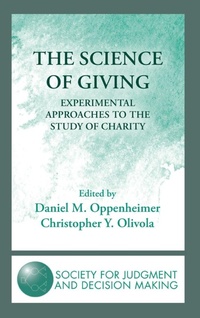
The Science of Giving
Experimental Approaches to the Study of Charity
1st Edition
Published on 21. October 2010
Book
Hardback
274 pages
978-1-84872-885-1 (ISBN)
Description
Americans donate over 300 billion dollars a year to charity, but the psychological factors that govern whether to give, and how much to give, are still not well understood. Our understanding of charitable giving is based primarily upon the intuitions of fundraisers or correlational data which cannot establish causal relationships. By contrast, the chapters in this book study charity using experimental methods in which the variables of interest are experimentally manipulated. As a result, it becomes possible to identify the causal factors that underlie giving, and to design effective intervention programs that can help increase the likelihood and amount that people contribute to a cause.
For charitable organizations, this book examines the efficacy of fundraising strategies commonly used by nonprofits and makes concrete recommendations about how to make capital campaigns more efficient and effective. Moreover, a number of novel factors that influence giving are identified and explored, opening the door to exciting new avenues in fundraising.
For researchers, this book breaks novel theoretical ground in our understanding of how charitable decisions are made. While the chapters focus on applications to charity, the emotional, social, and cognitive mechanisms explored herein all have more general implications for the study of psychology and behavioral economics.
This book highlights some of the most intriguing, surprising, and enlightening experimental studies on the topic of donation behavior, opening up exciting pathways to cross-cutting the divide between theory and practice.
For charitable organizations, this book examines the efficacy of fundraising strategies commonly used by nonprofits and makes concrete recommendations about how to make capital campaigns more efficient and effective. Moreover, a number of novel factors that influence giving are identified and explored, opening the door to exciting new avenues in fundraising.
For researchers, this book breaks novel theoretical ground in our understanding of how charitable decisions are made. While the chapters focus on applications to charity, the emotional, social, and cognitive mechanisms explored herein all have more general implications for the study of psychology and behavioral economics.
This book highlights some of the most intriguing, surprising, and enlightening experimental studies on the topic of donation behavior, opening up exciting pathways to cross-cutting the divide between theory and practice.
Reviews / Votes
"The Science of Giving will be of interest to psychologists and economists interested in understanding how people decide whether, when, and how much to donate to charitable causes. It could also be a valuable supplement as a textbook for an upper level class in applications of social psychology. This book will also give all readers much to consider about their own charitable giving." - Catherine A. Sanderson, Amherst College, USA, in PsycCRITIQUES"The Science of Giving is full of information that may help a fundraiser make better decisions about how to approach donors. ... The book is a fine reference for the science of charitable giving as it stands today. ... [The Science of Giving] will yield many insights that can be applied to any organization's fundraising approach." - Joanne Fritz, About.com Guide
"I picked up this book and could not put it down. It masterfully links several important contributions on the market for charity. The even-handed approach should appeal to a broad audience, including academics, policymakers, and the general reader interested in the economics and psychology of charity markets." - John A. List, Professor, Department of Economics, University of Chicago, USA
More details
Series
Language
English
Place of publication
Hove
United Kingdom
Publishing group
Taylor & Francis Ltd
Target group
College/higher education
Illustrations
28 s/w Abbildungen, 19 s/w Tabellen
19 Tables, black and white; 28 Illustrations, black and white
Dimensions
Height: 235 mm
Width: 157 mm
Thickness: 19 mm
Weight
554 gr
ISBN-13
978-1-84872-885-1 (9781848728851)
Copyright in bibliographic data and cover images is held by Nielsen Book Services Limited or by the publishers or by their respective licensors: all rights reserved.
Schweitzer Classification
Other editions
Additional editions
Daniel M. Oppenheimer | Christopher Y. Olivola
The Science of Giving
Experimental Approaches to the Study of Charity
Book
11/2015
1st Edition
Psychology Press Ltd
€74.70
Shipment within 10-20 days
Daniel M. Oppenheimer | Christopher Y. Olivola
The Science of Giving
Experimental Approaches to the Study of Charity
E-Book
01/2011
Psychology Press Ltd
€68.49
Available for download
Daniel M. Oppenheimer | Christopher Y. Olivola
The Science of Giving
Experimental Approaches to the Study of Charity
E-Book
01/2011
Psychology Press Ltd
€68.49
Available for download
Persons
Daniel M. Oppenheimer, Christopher Y. Olivola
Content
D.M. Oppenheimer, C.Y. Olivola, Introduction. Part 1. The Value of Giving. L. Anik, L.B. Aknin, M.I. Norton, E.W. Dunn, Feeling Good about Giving: The Benefits (and Costs) of Self-Interested Charitable Behavior. M.A. Strahilevitz, A Model of the Value of Giving to Others Compared to the Value of Having More for Oneself: Implications for Fundraisers Seeking to Maximize Donor Satisfaction. T. Meyvis, A. Bennett, D.M. Oppenheimer, Pre-Commitment to Charity. C.Y. Olivola, When Noble Means Hinder Noble Ends: The Benefits and Costs of a Preference for Martyrdom in Altruism. Part 2. The Impact of Social Factors. R. Croson, J. Shang, Social Influences in Giving: Field Experiments in Public Radio. R. Martin, J. Randal, How Social Norms, Price, and Scrutiny Influence Donation Behavior: Evidence from Four Natural Field Experiments. R.K. Ratner, M. Zhao, J.A. Clarke, The Norm of Self-Interest: Implications for Charitable Giving. T. Kogut, I. Ritov, The Identifiable Victim Effect: Causes and Boundary Conditions. Part 3. The Role of Emotions. D.A. Small, Sympathy Biases and Sympathy Appeals: Reducing Social Distance to Boost Charitable Contribution. S. Dickert, N. Sagara, P. Slovic, Affective Motivations to Help Others: A Two-Stage Model of Donation Decisions. M. Huber, L. Van Boven, A.P. McGraw, Donate Different: External and Internal Influences on Emotion-Based Donation Decisions. Part 4. Other Important Influences on Charitable Giving. W. Liu, The Benefits of Asking for Time. J. Baron, E. Szymanska, Heuristics and Biases in Charity. C. Cryder, G. Loewenstein, The Critical Link Between Tangibility and Generosity.