

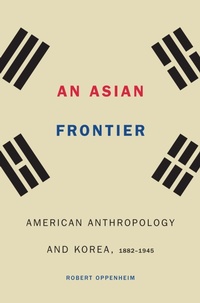
An Asian Frontier
American Anthropology and Korea, 1882-1945
Published on 1. June 2016
Book
Hardback
450 pages
978-0-8032-8561-3 (ISBN)
Description
In the nineteenth century the predominant focus of American anthropology centered on the native peoples of North America, and most anthropologists would argue that Korea during this period was hardly a cultural area of great anthropological interest. However, this perspective underestimates Korea as a significant object of concern for American anthropology during the period from 1882 to 1945-otherwise a turbulent, transitional period in Korea's history. An Asian Frontier focuses on the dialogue between the American anthropological tradition and Korea, from Korea's first treaty with the United States to the end of World War II, with the goal of rereading anthropology's history and theoretical development through its Pacific frontier.
Drawing on notebooks and personal correspondence as well as the publications of anthropologists of the day, Robert Oppenheim shows how and why Korea became an important object of study-with, for instance, more published about Korea in the pages of American Anthropologist before 1900 than would be seen for decades after. Oppenheim chronicles the actions of American collectors, Korean mediators, and metropolitan curators who first created Korean anthropological exhibitions for the public. He moves on to examine anthropologists-such as AleS Hrdlicka, Walter Hough, Stewart Culin, Frederick Starr, and Frank Hamilton Cushing-who fit Korea into frameworks of evolution, culture, and race even as they engaged questions of imperialism that were raised by Japan's colonization of the country. In tracing the development of American anthropology's understanding of Korea, Oppenheim discloses the legacy present in our ongoing understanding of Korea and of anthropology's past.
Drawing on notebooks and personal correspondence as well as the publications of anthropologists of the day, Robert Oppenheim shows how and why Korea became an important object of study-with, for instance, more published about Korea in the pages of American Anthropologist before 1900 than would be seen for decades after. Oppenheim chronicles the actions of American collectors, Korean mediators, and metropolitan curators who first created Korean anthropological exhibitions for the public. He moves on to examine anthropologists-such as AleS Hrdlicka, Walter Hough, Stewart Culin, Frederick Starr, and Frank Hamilton Cushing-who fit Korea into frameworks of evolution, culture, and race even as they engaged questions of imperialism that were raised by Japan's colonization of the country. In tracing the development of American anthropology's understanding of Korea, Oppenheim discloses the legacy present in our ongoing understanding of Korea and of anthropology's past.
Reviews / Votes
"An Asian Frontier makes a novel contribution to the history of anthropology and to the history of the study of Korea. . . . Interesting, provocative, and singular."-Laura Nelson, associate professor of women's and gender studies at the University of California, Berkeley, and author of Measured Excess: Status, Gender, and Consumer Nationalism in South Korea"Oppenheim's research and writing are informed by sophisticated perspectives on how science is done and its results communicated. . . . A major contribution to seeing non-Americanist work during the time in which museums and university departments of anthropology began."-Stephen O. Murray, director of El Instituto ObregOn in San Francisco and coauthor of Looking Through Taiwan: American Anthropologists' Collusion with Ethnic Domination
More details
Series
Language
English
Place of publication
Lincoln
United States
Target group
Professional and scholarly
College/higher education
Product notice
Cloth over boards
Illustrations
7 illustrations
Dimensions
Height: 236 mm
Width: 161 mm
Thickness: 38 mm
Weight
789 gr
ISBN-13
978-0-8032-8561-3 (9780803285613)
Copyright in bibliographic data and cover images is held by Nielsen Book Services Limited or by the publishers or by their respective licensors: all rights reserved.
Schweitzer Classification
Other editions
Additional editions
E-Book
06/2016
1st Edition
University of Nebraska Press
€82.49
Available for download
E-Book
06/2016
1st Edition
University of Nebraska Press
€92.49
Available for download
Person
Robert Oppenheim is an associate professor of Asian studies and anthropology at the University of Texas at Austin. He is the author of Kyongju Things: Assembling Place.
Content
List of FiguresSeries Editors' IntroductionAcknowledgmentsNote on Editorial MethodIntroduction: Tracings of Discipline and Shadows of Area1. Anthropological Collecting Networks in Late Nineteenth-Century Korea2. Ceramic Economies3. From China in America to Korea in Chicago4. Orientalist against Orientalism5. The Anthropologist without Qualities6. Worlding Korea from Without and Within7. Interwar Asymmetries of Race and Anti-imperialismConclusion: LegaciesSource AcknowledgmentsNotesBibliographyIndex