

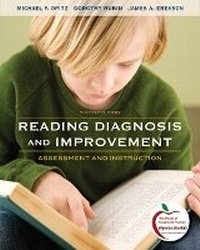
Reading Diagnosis and Improvement
Assessment and Instruction
6th Edition
Published on 12. August 2010
Book
Paperback/Softback
480 pages
978-0-13-705639-2 (ISBN)
Description
This best-selling guide to diagnosing and improving reading is based on the authors' premise that when assessment and instruction are centric to a reading program, children's reading improvement can occur. In Reading Diagnosis and Improvement: Assessment and Instruction, 6/e, well respected authors Dorothy Rubin, Michael Opitz, and James Erekson set the stage for effective reading diagnosis and improvement, describe various assessment measures teachers can use to assess and diagnose students' reading performance, and present reading content and instruction. It's an ideal blend of theory and practice, including many practical applications of the material covered; suggestions for constructing an informal reading inventory; and a complete, ready to use informal reading inventory.
More details
Edition
6th edition
Language
English
Place of publication
United States
Publishing group
Pearson Education (US)
Target group
Professional and scholarly
Dimensions
Height: 204 mm
Width: 253 mm
Thickness: 16 mm
Weight
862 gr
ISBN-13
978-0-13-705639-2 (9780137056392)
Copyright in bibliographic data and cover images is held by Nielsen Book Services Limited or by the publishers or by their respective licensors: all rights reserved.
Schweitzer Classification
Other editions
New editions
Book
03/2014
7th Edition
Pearson
Unfortunately, price unknown
Article is exhausted; no reprint
Previous edition
Dorothy Rubin | Michael Opitz
Diagnosis and Improvement in Reading Instruction
Book
10/2006
5th Edition
Pearson
€101.83
Article exhausted; check for reprint
Persons
Michael F. Opitz
A former elementary school teacher and reading specialist, Dr. Michael F. Opitz is currently a professor of reading at the University of Northern Colorado where he teaches undergraduate and graduate literacy courses and works with doctoral candidates. He is the author and coauthor of several books on such topics as comprehensive and English language learners, ways to enhance listening comprehension, cross proficiency levels, means for reaching readers, strategies for guided reading, literature and language play for phonological awareness, and literacy instruction for culturally and linguistically diverse students. Michael is also an author of a supplemental reading program aimed at engaging boys with reading, a supplemental literacy program, an intervention program tailored to children who need additional help with reading, and a reading program designed to help children who need additional help with reading among others. His articles appear in professional and trade journals. Dr. Opitz works in selected classrooms in the US and abroad planning, teaching and evaluating demonstration lessons focused on different aspects of literacy; provides in-service and staff development sessions; serves as a consultant; and presents at state and international conferences.
James A. Erekson
Dr. James A. Erekson is an assistant professor of reading at the University of Northern Colorado where he teaches undergraduate and graduate literacy courses and works with doctoral candidates. He has extensive K-12 classroom experience, including first through third grade literacy teaching, and running a middle school reading intervention program. Dr Erekson's professional background in Learning and Development has helped him stay focused on the needs of learners in educational settings. He has also taught college-level language courses, with experience in five languages besides English. His research publications appear in national and regional literacy journals, he provides in-service and staff development sessions, serves as a consultant, and presents at state and international conferences.
Dorothy Rubin
Dorothy Rubin has a Bachelor's degree and a Master's degree from Rutgers University, and she has a Ph. D. from John Hopkins University. She has written many textbooks for teacher education and for student learning. She has also taught reading through the elementary grades. She is an authority in all aspects of reading instruction as well as vocabulary development. Currently, she is a Professor Emerita with the College of New Jersey.
A former elementary school teacher and reading specialist, Dr. Michael F. Opitz is currently a professor of reading at the University of Northern Colorado where he teaches undergraduate and graduate literacy courses and works with doctoral candidates. He is the author and coauthor of several books on such topics as comprehensive and English language learners, ways to enhance listening comprehension, cross proficiency levels, means for reaching readers, strategies for guided reading, literature and language play for phonological awareness, and literacy instruction for culturally and linguistically diverse students. Michael is also an author of a supplemental reading program aimed at engaging boys with reading, a supplemental literacy program, an intervention program tailored to children who need additional help with reading, and a reading program designed to help children who need additional help with reading among others. His articles appear in professional and trade journals. Dr. Opitz works in selected classrooms in the US and abroad planning, teaching and evaluating demonstration lessons focused on different aspects of literacy; provides in-service and staff development sessions; serves as a consultant; and presents at state and international conferences.
James A. Erekson
Dr. James A. Erekson is an assistant professor of reading at the University of Northern Colorado where he teaches undergraduate and graduate literacy courses and works with doctoral candidates. He has extensive K-12 classroom experience, including first through third grade literacy teaching, and running a middle school reading intervention program. Dr Erekson's professional background in Learning and Development has helped him stay focused on the needs of learners in educational settings. He has also taught college-level language courses, with experience in five languages besides English. His research publications appear in national and regional literacy journals, he provides in-service and staff development sessions, serves as a consultant, and presents at state and international conferences.
Dorothy Rubin
Dorothy Rubin has a Bachelor's degree and a Master's degree from Rutgers University, and she has a Ph. D. from John Hopkins University. She has written many textbooks for teacher education and for student learning. She has also taught reading through the elementary grades. She is an authority in all aspects of reading instruction as well as vocabulary development. Currently, she is a Professor Emerita with the College of New Jersey.
Content
Brief Contents Part 1 Setting the Stage
1 What is Reading Diagnosis and Improvement?
2 Teaching for Reading and Improvement
3 Developing a Knowledge Base about Tests, Measurement, and Evaluation
4 Factors that Affect Reading Performance
Part 2 Assessing Reading
5 Using Informal Assessment Techniques across the Grades
6 Using Standardized Assessments across grade levels
7 Assessing and Teaching Early Literacy
8 Listening in on Students' Oral Reading
Part 3 Content and Instruction
9 Using Texts to Help Children Advance as readers
10 Helping Children comprehend
11 Helping Children Acquire and Apply Vocabulary
12 Helping Children Apply Phonics
13 Learning Strategies and Study Skills
14 Partnering with Parents
15 Putting It All Together
Appendices
Appendix A Constructing an Informal Reading Inventory
Appendix B Informal Reading Inventory
Appendix C Teacher's Resource Guide of Language Transfer Issues For English Language Learners
Appendix D International Reading Association Commission on Response to Intervention
Glossary
Index
1 What is Reading Diagnosis and Improvement?
2 Teaching for Reading and Improvement
3 Developing a Knowledge Base about Tests, Measurement, and Evaluation
4 Factors that Affect Reading Performance
Part 2 Assessing Reading
5 Using Informal Assessment Techniques across the Grades
6 Using Standardized Assessments across grade levels
7 Assessing and Teaching Early Literacy
8 Listening in on Students' Oral Reading
Part 3 Content and Instruction
9 Using Texts to Help Children Advance as readers
10 Helping Children comprehend
11 Helping Children Acquire and Apply Vocabulary
12 Helping Children Apply Phonics
13 Learning Strategies and Study Skills
14 Partnering with Parents
15 Putting It All Together
Appendices
Appendix A Constructing an Informal Reading Inventory
Appendix B Informal Reading Inventory
Appendix C Teacher's Resource Guide of Language Transfer Issues For English Language Learners
Appendix D International Reading Association Commission on Response to Intervention
Glossary
Index