

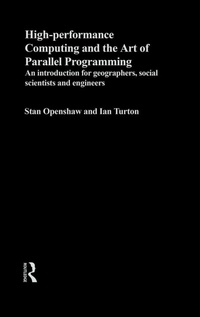
High Performance Computing and the Art of Parallel Programming
An Introduction for Geographers, Social Scientists and Engineers
1st Edition
Published on 25. November 1999
Book
Hardback
304 pages
978-0-415-15692-9 (ISBN)
Description
This book provides a non-technical introduction to High Performance Computing applications together with advice about how beginners can start to write parallel programs. The authors show what HPC can offer geographers and social scientists and how it can be used in GIS. They provide examples of where it has already been used and suggestions for other areas of application in geography and the social sciences. Case studies drawn from geography explain the key principles and help to understand the logic and thought processes that lie behind the parallel programming.
More details
Language
English
Place of publication
London
United Kingdom
Publishing group
Taylor & Francis Ltd
Target group
College/higher education
Professional and scholarly
Illustrations
29 s/w Tabellen
29 Tables, black and white
Dimensions
Height: 240 mm
Width: 161 mm
Thickness: 21 mm
Weight
628 gr
ISBN-13
978-0-415-15692-9 (9780415156929)
Copyright in bibliographic data and cover images is held by Nielsen Book Services Limited or by the publishers or by their respective licensors: all rights reserved.
Schweitzer Classification
Other editions
Additional editions
Stan Openshaw | Ian Turton
High Performance Computing and the Art of Parallel Programming
An Introduction for Geographers, Social Scientists and Engineers
E-Book
09/2005
Routledge
€60.49
Available for download
Stan Openshaw | Ian Turton
High Performance Computing and the Art of Parallel Programming
An Introduction for Geographers, Social Scientists and Engineers
E-Book
09/2005
Routledge
€60.49
Available for download
Persons
Stan Openshaw, Ian Turton
Content
Chapter 1. High Performance Computing: why bother with it?
Chapter 2. High Performance Computing applications in Geography and GIS
Chapter 3. Parallel and High Performance Computing: Concepts, Principles and Theory
Chapter 4. Types of Parallel Processing Hardware and Programming Paradigms
Chapter 5. Programming Vector Supercomputers
Chapter 6. Shared Loop and Data Parallel Programming
Chapter 7. Parallel Programming using Simple Message Passing
Chapter 8. Parallelising the Geographical Analysis Machine using MPI
Chapter 9. Optimising performance and debugging hints
Chapter 10. Putting it all together
Chapter 11. Epiglogue for Geographical and Social Scientists
Chapter 2. High Performance Computing applications in Geography and GIS
Chapter 3. Parallel and High Performance Computing: Concepts, Principles and Theory
Chapter 4. Types of Parallel Processing Hardware and Programming Paradigms
Chapter 5. Programming Vector Supercomputers
Chapter 6. Shared Loop and Data Parallel Programming
Chapter 7. Parallel Programming using Simple Message Passing
Chapter 8. Parallelising the Geographical Analysis Machine using MPI
Chapter 9. Optimising performance and debugging hints
Chapter 10. Putting it all together
Chapter 11. Epiglogue for Geographical and Social Scientists