

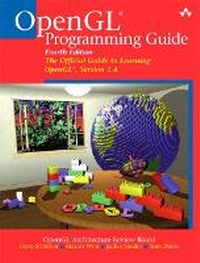
OpenGL (R) Programming Guide
The Official Guide to Learning OpenGL (R), Version 1.4
4th Edition
Published on 27. November 2003
Book
Paperback/Softback
816 pages
978-0-321-17348-5 (ISBN)
Description
The OpenGL Programming Guide provides definitive and comprehensive information on OpenGL and the OpenGL Utility Library. The previous edition covered OpenGL through version 1.2. This fourth edition of the bestselling guide will describe all of the latest features of OpenGL versions 1.3 and 1.4, as well as the important OpenGL ARB extensions. Some of the new features in the core library include cube-mapped texture mapping, multi-texturing, multi-sampled anti-aliasing, depth-texturing and shadows, and advanced texture application modes. Most importantly, the ARB vertex and fragment program extension (commonly referred to as "shaders") will be introduced. Many new example programs and color slides have been incorporated as well. As with all of the previous editions, this one was developed under the auspices of the OpenGL Architecture Review Board, and industry consortium responsible for guiding the evolution of OpenGL, and written by some of the most influential developers in the field.
More details
Edition
4th edition
Language
English
Place of publication
New Jersey
United States
Publishing group
Pearson Education (US)
Target group
College/higher education
Dimensions
Height: 234 mm
Width: 178 mm
Thickness: 37 mm
Weight
1216 gr
ISBN-13
978-0-321-17348-5 (9780321173485)
Copyright in bibliographic data and cover images is held by Nielsen Book Services Limited or by the publishers or by their respective licensors: all rights reserved.
Schweitzer Classification
Other editions
New editions
John Kessenich | Graham Sellers | Dave Shreiner
OpenGL Programming Guide
The Official Guide to Learning OpenGL, Version 4.5 with SPIR-V
Book
10/2016
9th Edition
Addison Wesley
€63.50
Shipment within 15-20 days
OpenGL Architecture Review Board, et al. | Dave Shreiner | Mason Woo
OpenGL Programming Guide
The Official Guide to Learning OpenGL, Version 2
Book
08/2005
5th Edition
Addison Wesley
€53.22
Article exhausted; check for reprint
Previous edition
OpenGL Architecture Review Board, et al. | Mason Woo | Jackie Neider
OpenGL (R) Programming Guide
The Official Guide to Learning OpenGL, Version 1.2
Book
09/1999
3rd Edition
Addison Wesley
€56.94
Article exhausted; check for reprint
Persons
0321173481AB06132006
Content
About This Guide.
What This Guide Contains.
What's New in This Edition.
What You Should Know Before Reading This Guide.
How to Obtain the Sample Code.
Nate Robins' OpenGL Tutors.
Errata.
Style Conventions.
Acknowledgments.
1. Introduction to OpenGL.
What Is OpenGL?
A Smidgen of OpenGL Code.
OpenGL Command Syntax.
OpenGL as a State Machine.
OpenGL Rendering Pipeline.
OpenGL-Related Libraries.
Animation.
2. State Management and Drawing Geometric Objects.
A Drawing Survival Kit.
Describing Points, Lines, and Polygons.
Basic State Management.
Displaying Points, Lines, and Polygons.
Normal Vectors.
Vertex Arrays.
Attribute Groups.
Some Hints for Building Polygonal Models of Surfaces.
3. Viewing.
Overview: The Camera Analogy.
Viewing and Modeling Transformations.
Projection Transformations.
Viewport Transformation.
Troubleshooting Transformations.
Manipulating the Matrix Stacks.
Additional Clipping Planes.
Examples of Composing Several Transformations.
Reversing or Mimicking Transformations.
4. Color.
Color Perception.
Computer Color.
Specifying a Color and a Shading Model.
5. Lighting.
A Hidden-Surface Removal Survival Kit.
Real-World and OpenGL Lighting.
A Simple Example: Rendering a Lit Sphere.
Creating Light Sources.
Selecting a Lighting Model.
Defining Material Properties.
The Mathematics of Lighting.
Lighting in Color-Index Mode.
6. Blending, Antialiasing, Fog, and Polygon Offset.
Blending.
Antialiasing.
Fog.
Point Parameters.
Polygon Offset.
7. Display Lists.
Why Use Display Lists?
An Example of Using a Display List.
Display List Design Philosophy.
Creating and Executing a Display List.
Executing Multiple Display Lists.
Managing State Variables with Display Lists.
8. Drawing Pixels, Bitmaps, Fonts, and Images.
Bitmaps and Fonts.
Images.
Imaging Pipeline.
Reading and Drawing Pixel Rectangles.
Tips for Improving Pixel Drawing Rates.
Imaging Subset.
9. Texture Mapping.
An Overview and an Example.
Specifying the Texture.
Filtering.
Texture Objects.
Texture Functions.
Assigning Texture Coordinates.
Automatic Texture-Coordinate Generation.
Multitexturing.
Texture Combiner Functions.
Applying Secondary Color after Texturing.
The Texture Matrix Stack.
Depth Textures.
10. The Framebuffer.
Buffers and Their Uses.
Testing and Operating on Fragments.
The Accumulation Buffer.
11. Tessellators and Quadrics.
Polygon Tessellation.
Quadrics: Rendering Spheres, Cylinders, and Disks.
12. Evaluators and NURBS.
Prerequisites.
Evaluators.
The GLU NURBS Interface.
13. Selection and Feedback.
Selection.
Feedback.
14. Now That You Know.
Error Handling.
Which Version Am I Using?
Extensions to the Standard.
Cheesy Translucency.
An Easy Fade Effect.
Object Selection Using the Back Buffer.
Cheap Image Transformation.
Displaying Layers.
Antialiased Characters.
Drawing Round Points.
Interpolating Images.
Making Decals.
Drawing Filled, Concave Polygons Using the Stencil Buffer.
Finding Interference Regions.
Shadows.
Hidden-Line Removal.
Texture Mapping Applications.
Drawing Depth-Buffered Images.
Dirichlet Domains.
Life in the Stencil Buffer.
Alternative Uses for glDrawPixels() and glCopyPixels().
Appendix A. Order of Operations.
Overview.
Geometric Operations.
Pixel Operations.
Fragment Operations.
Odds and Ends.
Appendix B. State Variables.
The Query Commands.
OpenGL State Variables.
Appendix C. OpenGL and Window Systems.
Accessing New OpenGL Functions.
GLX: OpenGL Extension for the X Window System.
AGL: OpenGL Extensions for the Apple Macintosh.
PGL: OpenGL Extension for IBM OS/2 Warp.
WGL: OpenGL Extension for Microsoft Windows 95/98/NT/ME/2000/XP.
Appendix D. Basics of GLUT: The OpenGL Utility Toolkit.
Initializing and Creating a Window.
Handling Window and Input Events.
Loading the Color Map.
Initializing and Drawing Three-Dimensional Objects.
Managing a Background Process.
Running the Program.
Appendix E. Calculating Normal Vectors.
Finding Normals for Analytic Surfaces.
Finding Normals from Polygonal Data.
Appendix F. Homogeneous Coordinates and Transformation Matrices.
Homogeneous Coordinates.
Transformation Matrices.
Appendix G. Programming Tips.
OpenGL Correctness Tips.
OpenGL Performance Tips.
GLX Tips.
Appendix H. OpenGL Invariance.
Glossary.
Index. 0321173481T10302003
What This Guide Contains.
What's New in This Edition.
What You Should Know Before Reading This Guide.
How to Obtain the Sample Code.
Nate Robins' OpenGL Tutors.
Errata.
Style Conventions.
Acknowledgments.
1. Introduction to OpenGL.
What Is OpenGL?
A Smidgen of OpenGL Code.
OpenGL Command Syntax.
OpenGL as a State Machine.
OpenGL Rendering Pipeline.
OpenGL-Related Libraries.
Animation.
2. State Management and Drawing Geometric Objects.
A Drawing Survival Kit.
Describing Points, Lines, and Polygons.
Basic State Management.
Displaying Points, Lines, and Polygons.
Normal Vectors.
Vertex Arrays.
Attribute Groups.
Some Hints for Building Polygonal Models of Surfaces.
3. Viewing.
Overview: The Camera Analogy.
Viewing and Modeling Transformations.
Projection Transformations.
Viewport Transformation.
Troubleshooting Transformations.
Manipulating the Matrix Stacks.
Additional Clipping Planes.
Examples of Composing Several Transformations.
Reversing or Mimicking Transformations.
4. Color.
Color Perception.
Computer Color.
Specifying a Color and a Shading Model.
5. Lighting.
A Hidden-Surface Removal Survival Kit.
Real-World and OpenGL Lighting.
A Simple Example: Rendering a Lit Sphere.
Creating Light Sources.
Selecting a Lighting Model.
Defining Material Properties.
The Mathematics of Lighting.
Lighting in Color-Index Mode.
6. Blending, Antialiasing, Fog, and Polygon Offset.
Blending.
Antialiasing.
Fog.
Point Parameters.
Polygon Offset.
7. Display Lists.
Why Use Display Lists?
An Example of Using a Display List.
Display List Design Philosophy.
Creating and Executing a Display List.
Executing Multiple Display Lists.
Managing State Variables with Display Lists.
8. Drawing Pixels, Bitmaps, Fonts, and Images.
Bitmaps and Fonts.
Images.
Imaging Pipeline.
Reading and Drawing Pixel Rectangles.
Tips for Improving Pixel Drawing Rates.
Imaging Subset.
9. Texture Mapping.
An Overview and an Example.
Specifying the Texture.
Filtering.
Texture Objects.
Texture Functions.
Assigning Texture Coordinates.
Automatic Texture-Coordinate Generation.
Multitexturing.
Texture Combiner Functions.
Applying Secondary Color after Texturing.
The Texture Matrix Stack.
Depth Textures.
10. The Framebuffer.
Buffers and Their Uses.
Testing and Operating on Fragments.
The Accumulation Buffer.
11. Tessellators and Quadrics.
Polygon Tessellation.
Quadrics: Rendering Spheres, Cylinders, and Disks.
12. Evaluators and NURBS.
Prerequisites.
Evaluators.
The GLU NURBS Interface.
13. Selection and Feedback.
Selection.
Feedback.
14. Now That You Know.
Error Handling.
Which Version Am I Using?
Extensions to the Standard.
Cheesy Translucency.
An Easy Fade Effect.
Object Selection Using the Back Buffer.
Cheap Image Transformation.
Displaying Layers.
Antialiased Characters.
Drawing Round Points.
Interpolating Images.
Making Decals.
Drawing Filled, Concave Polygons Using the Stencil Buffer.
Finding Interference Regions.
Shadows.
Hidden-Line Removal.
Texture Mapping Applications.
Drawing Depth-Buffered Images.
Dirichlet Domains.
Life in the Stencil Buffer.
Alternative Uses for glDrawPixels() and glCopyPixels().
Appendix A. Order of Operations.
Overview.
Geometric Operations.
Pixel Operations.
Fragment Operations.
Odds and Ends.
Appendix B. State Variables.
The Query Commands.
OpenGL State Variables.
Appendix C. OpenGL and Window Systems.
Accessing New OpenGL Functions.
GLX: OpenGL Extension for the X Window System.
AGL: OpenGL Extensions for the Apple Macintosh.
PGL: OpenGL Extension for IBM OS/2 Warp.
WGL: OpenGL Extension for Microsoft Windows 95/98/NT/ME/2000/XP.
Appendix D. Basics of GLUT: The OpenGL Utility Toolkit.
Initializing and Creating a Window.
Handling Window and Input Events.
Loading the Color Map.
Initializing and Drawing Three-Dimensional Objects.
Managing a Background Process.
Running the Program.
Appendix E. Calculating Normal Vectors.
Finding Normals for Analytic Surfaces.
Finding Normals from Polygonal Data.
Appendix F. Homogeneous Coordinates and Transformation Matrices.
Homogeneous Coordinates.
Transformation Matrices.
Appendix G. Programming Tips.
OpenGL Correctness Tips.
OpenGL Performance Tips.
GLX Tips.
Appendix H. OpenGL Invariance.
Glossary.
Index. 0321173481T10302003