

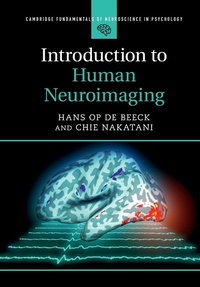
Introduction to Human Neuroimaging
Published on 16. May 2019
Book
Paperback/Softback
368 pages
978-1-316-63218-5 (ISBN)
Description
Developed specifically for students in the behavioral and brain sciences, this is the only textbook that provides an accessible and practical overview of the range of human neuroimaging techniques. Methods covered include functional and structural magnetic resonance imaging, positron emission tomography, electroencephalography, magnetoencephalography, multimodal imaging, and various brain stimulation methods. Experimental design, image processing, and statistical inference are also addressed, with chapters for both basic and more advanced data analyses. Key concepts are illustrated through research studies on the relationship between brain and behavior, and practice questions are included throughout to test knowledge and aid self-study. Offering just the right amount of detail for understanding how major imaging techniques can be applied to answer neuroscientific questions, and the practical skills needed for future research, this is an essential text for advanced undergraduate and graduate students in psychology, neuroscience, and cognitive science programs taking introductory courses on human neuroimaging.
Reviews / Votes
'This masterfully written text threads the needle between being a cutting-edge and comprehensive state-of-the-art reference on all human neuroimaging methods, and a highly accessible and perspective-building book that one will want to read from cover to cover. I look forward to purchasing a copy for everyone in my lab.' Peter Bandettini, Director of the Functional Magnetic Resonance Imaging Core Facility (FMRIF), National Institute of Health 'Well written, nicely illustrated, and authoritative, this book is certainly to be recommended both to those starting out in the field and to those wanting to deepen and widen their neuroimaging knowledge.' Vincent P. Giampietro, King's College London 'This is a valuable reference for those interested, and currently utilizing, human neuroimaging in their research. It provides a strong neurophysiological basis for the methods, a physics basis for the instrumentation, and modern analytical tools useful for the quantification of data. I highly recommend this book!' Lewis A. Wheaton, Georgia Institute of TechnologyMore details
Series
Language
English
Place of publication
Cambridge
United Kingdom
Target group
College/higher education
Product notice
Paperback (trade)
Illustrations
Worked examples or Exercises; 118 Plates, unspecified; 118 Halftones, color
Dimensions
Height: 244 mm
Width: 170 mm
Thickness: 21 mm
Weight
638 gr
ISBN-13
978-1-316-63218-5 (9781316632185)
Copyright in bibliographic data and cover images is held by Nielsen Book Services Limited or by the publishers or by their respective licensors: all rights reserved.
Schweitzer Classification
Other editions
New editions
Hans Op de Beeck | Chie Nakatani
Introduction to Human Neuroimaging
Book
10/2025
2nd Edition
Cambridge University Press
€71.00
Shipment within 15-20 days
Additional editions
Hans Op de Beeck | Chie Nakatani
Introduction to Human Neuroimaging
E-Book
05/2019
Cambridge University Press
€52.49
Available for download
Persons
Hans Op de Beeck is a Professor in the Faculty of Psychology and Educational Sciences at the University of Leuven (KU Leuven), and a member of the Laboratory of Biological Psychology (LBP) and the Brain and Cognition Research Unit. He is the recipient of a long-term fellowship and a career development award from the international Human Frontier Science Program (HFSP), an honorary fellowship of the Belgian-American Educational Foundation (BAEF), the KU Leuven Research Council Award in 2008, and the 2012 laureate of the Royal Flemish Academy of Belgium (KVAB). Chie Nakatani is a Postdoctoral Fellow in the Brain and Cognition Research Unit at the University of Leuven, having previously worked as a Research Scientist at the Laboratory for Perceptual Dynamics, RIKEN Brain Science Institute, Japan. She has a range of research and teaching experience with a particular focus on electroencephalography.
Content
1. Introduction and overview; Part I. Structural Neuroimaging: 2. The physics behind magnetic resonance imaging; 3. Structural imaging methods; Part II. Hemodynamic Neuroimaging: 4. Hemodynamic imaging methods; 5. Designing an hemodynamic imaging experiment; 6. Image processing; 7. Basic statistical analysis; 8. Advanced statistical analysis; Part III. Electrophysiological Neuroimaging: 9. Electromagnetic field of the brain; 10. Electroencephalography and magnetoencephalography; 11. Basic analysis of electrophysiological signals; 12. Advanced data analysis; Part IV. Complementary Methods: 13. Multi-modal imaging; 14. Causal methods to modulate brain activity.