

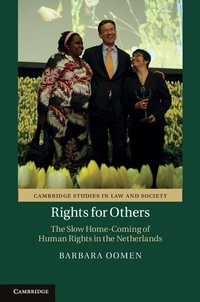
Rights for Others
The Slow Home-Coming of Human Rights in the Netherlands
Published on 28. November 2013
Book
Hardback
245 pages
978-1-107-04183-7 (ISBN)
Description
Rights for Others is an empirical study of what happens when international human rights are applied domestically in The Netherlands. It tracks recent debates in Dutch society on citizenship and the rights of immigrants, and analyses the shift from the perception of human rights as a 'foreign policy concern' to the slow processes of homecoming in what has traditionally been a left-wing society, but now includes many more right-wing political parties. Adopting an interdisciplinary approach, Oomen combines insights from law, sociology and anthropology to explain how rights gain significance in framing social and political discussions. The book provides comprehensive coverage on relevant constitutional law, legal culture and rights realization as well as discussing case material on human rights education, polarization, socio-economic rights, domestic violence and the rights of minorities. This is an invaluable contribution to the global fields of human rights and socio-legal studies for scholars and researchers.
More details
Series
Language
English
Place of publication
Cambridge
United Kingdom
Target group
Professional and scholarly
Dimensions
Height: 235 mm
Width: 157 mm
Thickness: 18 mm
Weight
512 gr
ISBN-13
978-1-107-04183-7 (9781107041837)
Copyright in bibliographic data and cover images is held by Nielsen Book Services Limited or by the publishers or by their respective licensors: all rights reserved.
Schweitzer Classification
Other editions
Additional editions
E-Book
11/2013
1st Edition
Cambridge University Press
€79.99
Available for download
E-Book
11/2013
Cambridge University Press
€66.49
Available for download
Person
Barbara Oomen holds a Chair in the Sociology of Human Rights at Utrecht University, The Netherlands, and is the Dean of University College Roosevelt. She teaches courses on topics including the origins and implementation of human rights, human rights cities and transitional justice. She is a former chair of the Netherlands Platform on Human Rights Education and a former member of the Commission on Human Rights of the Dutch Advisory Council on International Affairs and the Netherlands National Commission for Unesco. Currently, she is a member of the Advisory Council of the Netherlands Human Rights Institute. As a scholar, Professor Oomen has published extensively on the interrelationship between law, culture and society, focusing on themes like customary law, international criminal law and human rights law. She is the recipient of the Law and Society Association dissertation award and grants from amongst others the Netherlands Science Foundation, the Fulbright, the Ford Foundation. She is currently a member of an international research network on human rights integration, and works on the rise of human rights cities. This book brings together her experience as a scholar and as an activist in the field of human rights in The Netherlands.
Content
1. Introduction: the rights for others; 2. Internationalism as a constitutional identity; 3. Rights-free citizenship; 4. The struggle over human rights education; 5. A very un-Dutch case?; 6. Dealing with domestic violence the Dutch way; 7. Giving effect to social rights; 8. The rights of the reformed; 9. Conclusion: the contested homecoming of human rights.