

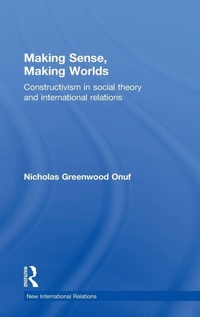
Making Sense, Making Worlds
Constructivism in Social Theory and International Relations
1st Edition
Published on 18. September 2012
Book
Hardback
256 pages
978-0-415-62416-9 (ISBN)
Description
Nicholas Onuf is a leading scholar in international relations and introduced constructivism to international relations, coining the term constructivism in his book World of Our Making (1989). He was featured as one of twelve scholars featured in Iver B. Neumann and Ole Waever, eds., The Future of International Relations: Masters in the Making? (1996); and featured in Martin Griffiths, Steven C. Roach and M. Scott Solomon, Fifty Key Thinkers in International Relations, 2nd ed. (2009).
This powerful collection of essays clarifies Onuf's approach to international relations and makes a decisive contribution to the debates in IR concerning theory. It embeds the theoretical project in the wider horizon of how we understand ourselves and the world. Onuf updates earlier themes and his general constructivist approach, and develops some newer lines of research, such as the work on metaphors and the re-grounding in much more Aristotle than before.
A complement to the author's groundbreaking book of 1989, World of Our Making, this tightly argued book draws extensively from philosophy and social theory to advance constructivism in International Relations.
Making Sense, Making Worlds will be vital reading for students and scholars of international relations, international relations theory, social theory and law.
This powerful collection of essays clarifies Onuf's approach to international relations and makes a decisive contribution to the debates in IR concerning theory. It embeds the theoretical project in the wider horizon of how we understand ourselves and the world. Onuf updates earlier themes and his general constructivist approach, and develops some newer lines of research, such as the work on metaphors and the re-grounding in much more Aristotle than before.
A complement to the author's groundbreaking book of 1989, World of Our Making, this tightly argued book draws extensively from philosophy and social theory to advance constructivism in International Relations.
Making Sense, Making Worlds will be vital reading for students and scholars of international relations, international relations theory, social theory and law.
More details
Series
Language
English
Place of publication
London
United Kingdom
Publishing group
Taylor & Francis Ltd
Target group
College/higher education
Dimensions
Height: 240 mm
Width: 161 mm
Thickness: 19 mm
Weight
555 gr
ISBN-13
978-0-415-62416-9 (9780415624169)
Copyright in bibliographic data and cover images is held by Nielsen Book Services Limited or by the publishers or by their respective licensors: all rights reserved.
Schweitzer Classification
Other editions
Additional editions
Nicholas Onuf
Making Sense, Making Worlds
Constructivism in Social Theory and International Relations
E-Book
05/2013
1st Edition
Routledge
€61.99
Available for download
Nicholas Onuf
Making Sense, Making Worlds
Constructivism in Social Theory and International Relations
E-Book
05/2013
1st Edition
Routledge
€61.99
Available for download
Nicholas Onuf
Making Sense, Making Worlds
Constructivism in Social Theory and International Relations
Book
09/2012
1st Edition
Routledge
€68.20
Shipment within 15-20 days
Person
Nicholas Greenwood Onuf is Professor Emeritus, Department of Politics and International Relations, Florida International University, Miami, and Professor Associado, Instituto de Relacoes Internationais, Pontifica Universidade Catolica do Rio de Janeiro.
Content
Preface Part I. Constructivism 1. Constructivism: A User's Manual 2. Worlds of Our Making 3. Fitting Metaphors Part II. The Metaphysics of World-Making 4. Reading Aristotle 5. Parsing Personal Identity 6. Structure, What Structure? Part III. The Art of World-Making 7. Speaking of Policy 8. Rules in Practice 9. Friendship and Hospitality Part IV. Making Sense of Modernity 10. Institutions, Intentions and International Relations 11. Civil Society, Global Governance 12. Alternative Visions