

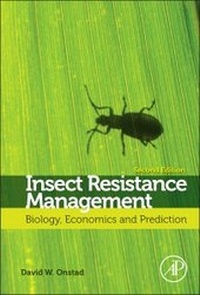
Insect Resistance Management
Biology, Economics, and Prediction
2nd Edition
Published on 23. October 2013
Book
Hardback
560 pages
978-0-12-396955-2 (ISBN)
Description
Neither pest management nor resistance management can occur with only an understanding of pest biology. For years, entomologists have understood, with their use of economic thresholds, that at least a minimal use of economics was necessary for proper integrated pest management. IRM is even more complicated and dependent on understanding and using socioeconomic factors. The new edition of Insect Resistance Management addresses these issues and much more.
Many new ideas, facts and case studies have been developed since the previous edition of Insect Resistance Management published. With a new chapter focusing on Resistance Mechanisms Related to Plant-incorporated Toxins and heavily expanded revisions of several existing chapters, this new volume will be an invaluable resource for IRM researchers, practitioners, professors and advanced students. Authors in this edition include professors at major universities, leaders in the chemical and seed industry, evolutionary biologists and active IRM practitioners. This revision also contains more information about IRM outside North America, and a modeling chapter contains a large new section on uncertainty analysis, a subject recently emphasized by the U.S. Environmental Protection Agency. The final chapter contains a section on insecticidal seed treatments.
No other book has the breadth of coverage of Insect Resistance Management, 2e. It not only covers molecular to economic issues, but also transgenic crops, seed treatments and other pest management tactics such as crop rotation. Major themes continuing from the first edition include the importance of using IRM in the integrated pest management paradigm, the need to study and account for pest behavior, and the influence of human behavior and decision making in IRM.
Many new ideas, facts and case studies have been developed since the previous edition of Insect Resistance Management published. With a new chapter focusing on Resistance Mechanisms Related to Plant-incorporated Toxins and heavily expanded revisions of several existing chapters, this new volume will be an invaluable resource for IRM researchers, practitioners, professors and advanced students. Authors in this edition include professors at major universities, leaders in the chemical and seed industry, evolutionary biologists and active IRM practitioners. This revision also contains more information about IRM outside North America, and a modeling chapter contains a large new section on uncertainty analysis, a subject recently emphasized by the U.S. Environmental Protection Agency. The final chapter contains a section on insecticidal seed treatments.
No other book has the breadth of coverage of Insect Resistance Management, 2e. It not only covers molecular to economic issues, but also transgenic crops, seed treatments and other pest management tactics such as crop rotation. Major themes continuing from the first edition include the importance of using IRM in the integrated pest management paradigm, the need to study and account for pest behavior, and the influence of human behavior and decision making in IRM.
Reviews / Votes
"...good editing has ensured a consistent writing style and prevented excess repetition. Also, the cross-referencing between the chapters helps tie them together. Nevertheless, the chapters stand very well on their own...a very readable prose." --Bulletin of the ESC"This updated edition...is an excellent overview of IRM; hopefully, future researchers will work closely with plant pathologists, plant breeders, and even medical scientists struggling with very similar issues plaguing society that appear to stem from very similar biological processes. Summing Up: Highly recommended." --CHOICE, July 2014
"...recent advances in this dynamic field are well documented and explained in the second edition of the book...easy to read and the language is very accessible to non-specialists, so it should be considered a very valuable reference for students and professional researchers interested in IRM, including insect pathologists involved in the use of entomopathogens for pest control." --Society for Invertebrate Pathology Newsletter, June 2014
"Contributors from entomology, agriculture, and economics explore aspects of managing insect resistance to pesticides, reporting their own results, reviewing those of others, and offering practical suggestions for applying them. Among the topics are understanding resistance and induced responses of insects to xenobiotics and insecticides in the age of "omics" and systems biology, concepts and complexities of population genetics,..." --ProtoView.com, February 2014
More details
Edition
2nd edition
Language
English
Place of publication
San Diego
United States
Publishing group
Elsevier Science Publishing Co Inc
Target group
College/higher education
Professional and scholarly
Pest control, crop science, agricultural economics researchers and scientists; entomologists; agricultural engineers; plant scientists; graduate-level students
Dimensions
Height: 229 mm
Width: 152 mm
Weight
940 gr
ISBN-13
978-0-12-396955-2 (9780123969552)
Copyright in bibliographic data and cover images is held by Nielsen Book Services Limited or by the publishers or by their respective licensors: all rights reserved.
Schweitzer Classification
Other editions
New editions
Book
10/2022
3rd Edition
Academic Press
€130.50
Shipment within 15-20 days
Additional editions
E-Book
10/2013
2nd Edition
Academic Press
€74.95
Available for download
Previous edition
Book
12/2007
Academic Press
€77.98
Article exhausted; check for reprint
Person
Dr. David W. Onstad has been an entomologist for over 40 years focusing on insect resistance management, insect epizootiology, economics of integrated pest management, and ecological modeling. He was elected fellow of the Entomological Society of America in 2022. Since retiring after 26 years as a professor at the University of Illinois, he has been the lead mathematical modeler for DuPont Pioneer/CortevaAgriscience in support of data-driven strategic decision-making, assessing resistance risks, and product registration and development of transgenic insecticidal crops.
Content
1. Major Issues in Insect Resistance Management
2. Valuing Pest Susceptibility to Control
3. Understanding Resistance and Induced Responses of Insects to Xenobiotics and Insecticides in the Age of "Omics" and Systems Biology
4. Resistance Mechanisms Related to Plant-incorporated Toxins
5. Concepts and Complexities of Population Genetics
6. Resistance by Ectoparasites
7. Insect Resistance to Crop Rotation
8. Arthropod Resistance to Crops
9. The Role of Landscapes in Insect Resistance Management
10. Negative Cross-Resistance: History, Present Status, and Emerging Opportunities
11. The Roles of Natural Enemies and Density-Dependent Mortality in Resistance Management
12. Insect Resistance Management: Adoption and Compliance
13. Modeling for Prediction and Management
14. Monitoring Resistance
15. IPM and Insect Resistance Management
2. Valuing Pest Susceptibility to Control
3. Understanding Resistance and Induced Responses of Insects to Xenobiotics and Insecticides in the Age of "Omics" and Systems Biology
4. Resistance Mechanisms Related to Plant-incorporated Toxins
5. Concepts and Complexities of Population Genetics
6. Resistance by Ectoparasites
7. Insect Resistance to Crop Rotation
8. Arthropod Resistance to Crops
9. The Role of Landscapes in Insect Resistance Management
10. Negative Cross-Resistance: History, Present Status, and Emerging Opportunities
11. The Roles of Natural Enemies and Density-Dependent Mortality in Resistance Management
12. Insect Resistance Management: Adoption and Compliance
13. Modeling for Prediction and Management
14. Monitoring Resistance
15. IPM and Insect Resistance Management