

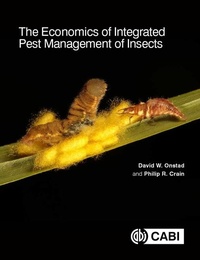
Economics of Integrated Pest Management of Insects, The
Published on 2. September 2019
Book
Hardback
232 pages
978-1-78639-367-8 (ISBN)
Description
Many biological studies on insect management do not consider economics or fundamental economic principles. This book brings together economists and entomologists to explain the principles, successes, and challenges of effective insect management. It highlights the importance of economic analyses for decision making and the feasibility of such approaches, and examines integrated pest management (IPM) practices from around the world with an emphasis on agriculture and public health. The book begins by establishing an economic framework upon which to apply the principles of IPM. It continues to examine the entomological applications of economics, specifically, economic analyses concerning chemical, biological, and genetic control tactics as well as host plant resistance and the cost of sampling and is illustrated with case studies of economic-based IPM programs from around the world.
More details
Language
English
Place of publication
Wallingford
United Kingdom
Dimensions
Height: 252 mm
Width: 188 mm
Thickness: 17 mm
Weight
718 gr
ISBN-13
978-1-78639-367-8 (9781786393678)
Copyright in bibliographic data and cover images is held by Nielsen Book Services Limited or by the publishers or by their respective licensors: all rights reserved.
Schweitzer Classification
Other editions
Additional editions
David W. Onstad | Philip R. Crain
Economics of Integrated Pest Management of Insects, The
E-Book
09/2019
CABI Publishing
€127.99
Available for download
Persons
David W Onstad (Edited By)
David Onstad received his Ph.D. at Cornell University in 1985. He was a professor at the University of Illinois until 2011 when he joined DuPont Pioneer. His expertise includes economic entomology, systems analysis, ecology, and pest management. The second edition of his book on insect resistance management was published in 2014.
Philip Crain (Edited By)
Philip Crain received his Ph.D. in Entomology from the University of Kentucky studying novel mosquito control strategies. After a post-doctoral research position at Westfaelische-Wilhelms Universitaet in Muenster, Germany, he joined the insect resistance management research team at DuPont Pioneer. Philip has a strong ecological background, and promotes the use of computer models to understand complex interactions. Population genetics and population dynamics models should include economic analysis if the goal is control of pests or disease.
David Onstad received his Ph.D. at Cornell University in 1985. He was a professor at the University of Illinois until 2011 when he joined DuPont Pioneer. His expertise includes economic entomology, systems analysis, ecology, and pest management. The second edition of his book on insect resistance management was published in 2014.
Philip Crain (Edited By)
Philip Crain received his Ph.D. in Entomology from the University of Kentucky studying novel mosquito control strategies. After a post-doctoral research position at Westfaelische-Wilhelms Universitaet in Muenster, Germany, he joined the insect resistance management research team at DuPont Pioneer. Philip has a strong ecological background, and promotes the use of computer models to understand complex interactions. Population genetics and population dynamics models should include economic analysis if the goal is control of pests or disease.
Editor
Corteva Agriscience, USA
Corteva Agriscience, USA
Contributions
Virginia Polytechnic Institute and State, USA
North Carolina State University, USA
Embrapa Soja, Brazil
University of Arizona, USA
Agronomic Institute of Parana , Brazil
University of Arizona, USA
Brandeis University, USA
Iowa State University, USA
Content
1: Major Economic Issues in Integrated Pest Management 2: Economic Evaluation of Integrated Mosquito Control in Urban Areas 3: What Can We Learn from More Recent (and More 'Rigorous') Economic Impact Assessments of Integrated Pest Management Farmer Field Schools (IPM-FFS)? 4: Economic Value of Arthropod Biological Control 5: Economics of Host-Plant Resistance 6: Economic Principles and Concepts in Area-Wide Genetic Pest Management 7: Economic Thresholds and Sampling in Integrated Pest Management 8: Economic Impacts of Integrated Pest Management Practices in Developing Countries 9: The Roles of Soft Technologies and Cooperative Extension in Solving Wicked Integrated Pest Management Problems 10: Perseverance Pays Off: Finishing the Integrated Pest Management Marathon with Economics