

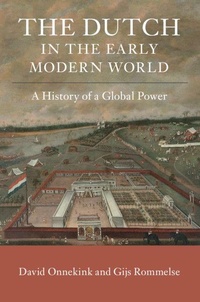
The Dutch in the Early Modern World
A History of a Global Power
Published on 6. June 2019
Book
Paperback/Softback
314 pages
978-1-107-57292-8 (ISBN)
Description
Emerging at the turn of the seventeenth century, the Dutch Republic rose to become a powerhouse of economic growth, artistic creativity, military innovation, religious tolerance and intellectual development. This is the first textbook to present this period of early modern Dutch history in a global context. It makes an active use of illustrations, objects, personal stories and anecdotes to present a lively overview of Dutch global history that is solidly grounded in sources and literature. Focusing on themes that resonate with contemporary concerns, such as overseas exploration, war, slavery, migration, identity and racism, this volume charts the multiple ways in which the Dutch were connected with the outside world. It serves as an engaging and accessible introduction to Dutch history as well as a case study in early modern global expansion.
Reviews / Votes
'A clear, fascinating, and comprehensive guide to a truly global Netherlands; setting diplomatic, military, and imperial history in a rich cultural context.' Tony Claydon, University of Bangor 'Vividly written and original in approach, this book is an impressive achievement. Onnekink and Rommelse take a broad view of international history, linking the Dutch Republic's policy in Europe with its trading ventures in Asia, Africa and the Americas. In the process they throw much fresh light on their subject, from the culture of diplomacy to the science of overseas expansion. For all this and more, their account will be widely welcomed.' Hugh Dunthorne, University of Swansea 'A well written narrative of Dutch foreign policy from revolt (1579) to revolution (1795) and set those developments within a wider socio-economic and cultural context. This work represents the best of the New Diplomatic history and fills lacunae in both Dutch and Early Modern European history. A carefully crafted and wittily argued tale, this book is highly recommended.' Linda Frey and Marsha Frey, University of Montana and Kansas State University 'A fast-paced, well-informed account of the rise, decline and fall of the Dutch Republic 1600-1800. It offers many challenging new insights, interweaving as it does the dynamics driving Dutch culture and society with the global maritime power of its merchant empire.' Reinier Salverda, University College London 'It can certainly be useful as a handbook for students.' Joris van den Tol, European History QuarterlyMore details
Language
English
Place of publication
Cambridge
United Kingdom
Target group
College/higher education
Professional and scholarly
Product notice
Paperback (trade)
Illustrations
3 Maps; 17 Halftones, black and white
Dimensions
Height: 229 mm
Width: 152 mm
Thickness: 18 mm
Weight
460 gr
ISBN-13
978-1-107-57292-8 (9781107572928)
Copyright in bibliographic data and cover images is held by Nielsen Book Services Limited or by the publishers or by their respective licensors: all rights reserved.
Schweitzer Classification
Other editions
Additional editions
Book
06/2019
Cambridge University Press
€120.20
Shipment within 15-20 days
E-Book
05/2019
Cambridge University Press
€23.49
Available for download
Persons
David Onnekink is Assistant Professor in Early Modern International Relations at Universiteit Utrecht, The Netherlands. He has previously held a positions at Leiden University, and was a visiting professor at William and Mary College and University of California, Los Angeles. He has been a fellow at The Institute for Advanced Studies in Humanities at Edinburgh (2004), Het Scheepvaartmuseum in Amsterdam (2016-17) and the Netherlands Institute for Advanced Study (2016). He is the author of Reinterpreting the Dutch Forty Years War (2016) and the edited volumes War and Religion after Westphalia, 1648-1713 (2009) and Ideology and Foreign Policy in Early Modern Europe (1650-1750) (2011) with Gijs Rommelse.
Content
Introduction; 1. The emerging republic (1579-1609); 2. The confident republic (1609-50); 3. The ascendant republic (1650-72); 4. The combatant republic (1672-1713); 5. The stagnant republic (1713-47); 6. The dissolving republic (1747-95); Epilogue.