

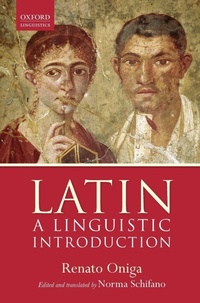
Latin: A Linguistic Introduction
A Linguistic Introduction
Published on 21. August 2014
Book
Hardback
364 pages
978-0-19-870285-6 (ISBN)
Description
This textbook provides a detailed introduction to the study of Latin from the perspective of contemporary linguistics. It adopts some basic tenets of generative grammar in an in-depth analysis of the main phonological, morphological, and syntactic properties of Latin, and offers a step-by-step guide to the universal principles and specific parameters which shape the language, along with comparative data from English and other languages.
Latin: A Linguistic Introduction is a user-friendly and essential guide to the synchronic study of Latin as a natural language. The clarity of exposition and the richness of the examples cited provide a new approach to Latin as a topic of linguistic research: although the general structure of the book is like that of a traditional Latin grammar, the discussion of grammatical rules is both more straightforward and more theoretically informed.
This textbook is principally suitable for students of Latin and Romance linguistics at undergraduate level and above, but also for teachers and researchers interested in new ways of looking at the study of Latin. It differs from many other textbooks in the field by striking a valuable balance between the longstanding tradition of classical philology and the innovations of contemporary linguistics.
Latin: A Linguistic Introduction is a user-friendly and essential guide to the synchronic study of Latin as a natural language. The clarity of exposition and the richness of the examples cited provide a new approach to Latin as a topic of linguistic research: although the general structure of the book is like that of a traditional Latin grammar, the discussion of grammatical rules is both more straightforward and more theoretically informed.
This textbook is principally suitable for students of Latin and Romance linguistics at undergraduate level and above, but also for teachers and researchers interested in new ways of looking at the study of Latin. It differs from many other textbooks in the field by striking a valuable balance between the longstanding tradition of classical philology and the innovations of contemporary linguistics.
Reviews / Votes
The book is exceptionally user-friendly: the layout is very pleasant It is an admirable work and one must congratulate not only Renato Oniga and Norma Schifano, but also Oxford University Press on publishing the text. * Graecolatina Pragensia *More details
Language
English
Place of publication
Oxford
United Kingdom
Target group
College/higher education
Dimensions
Height: 250 mm
Width: 175 mm
Thickness: 24 mm
Weight
807 gr
ISBN-13
978-0-19-870285-6 (9780198702856)
Copyright in bibliographic data and cover images is held by Nielsen Book Services Limited or by the publishers or by their respective licensors: all rights reserved.
Schweitzer Classification
Other editions
Additional editions
Renato Oniga
Latin: A Linguistic Introduction
Book
08/2014
Oxford University Press
€49.59
Shipment within 15-20 days
Renato Oniga
Latin: A Linguistic Introduction
E-Book
08/2014
1st Edition
OUP eBook
€25.49
Available for download
Persons
Renato Oniga is Professor of Latin at the University of Udine, Italy. He translated Plautus, Anfitrione (Venice, Marsilio, 1991) and Tacitus, Opera Omnia (Turin, Einaudi, 2005). His contributions to Latin linguistics include the monograph I composti nominali latini (Bologna, Patron, 1988) as well as several volumes as editor: the revised Italian version of Lateinische Stilistik by J.B. Hofmann and A. Szantyr (Bologna, Patron, 2002); Il plurilinguismo nella tradizione letteraria latina (Rome, Il Calamo, 2003); Atti della Giornata di Linguistica Latina (Venice, Cafoscarina, 2006); Formal Linguistics and the Teaching of Latin (Newcastle, Cambridge Scholars Publishing, 2011); and Lingue antiche e moderne dai licei alle universita (Bologna, Il Mulino, 2012). He is Editor-in-Chief of the international online journal Lingue antiche e moderne.
Norma Schifano is a PhD student and Gates Scholar of Romance linguistics at the Department of Italian, University of Cambridge. She is currently working on a comparative study of verb-movement across different Romance varieties.
Norma Schifano is a PhD student and Gates Scholar of Romance linguistics at the Department of Italian, University of Cambridge. She is currently working on a comparative study of verb-movement across different Romance varieties.
Content
PART I: PHONOLOGY; PART II: MORPHOLOGY; PART III: SYNTAX