

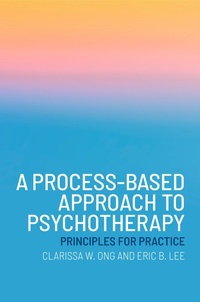
A Process-Based Approach to Psychotherapy
Principles for Practice
Published on 20. October 2025
Book
Paperback/Softback
240 pages
978-0-19-769637-8 (ISBN)
Description
Process-based therapy (PBT) is an approach to psychological assessment and treatment centered on processes of change in particular people in their unique context. A flexible framework, the PBT model allows for any practitioner of evidence-based therapy like CBT or ACT to use PBT to conceptualize clients and inform treatment planning and decisions, while retaining their own orientation's language and techniques.
A Process-Based Approach to Psychotherapy: Principles for Practice provides a practical foundation for clinicians, including graduate students, who are interested in learning how to deliver PBT. The book teaches readers how to, within a process-based model, develop a functional case conceptualization, assess client progress throughout treatment, and plan and adjust treatment in response to how a client is doing. Avoiding in-depth discussion of theoretical concepts, the authors instead provide practical principles and actionable steps for doing PBT, including case examples and exercises to facilitate a structured learning experience. Readers will come away with fundamental understanding of PBT that will allow them to immediately begin incorporating the model into their own practice.
A Process-Based Approach to Psychotherapy: Principles for Practice provides a practical foundation for clinicians, including graduate students, who are interested in learning how to deliver PBT. The book teaches readers how to, within a process-based model, develop a functional case conceptualization, assess client progress throughout treatment, and plan and adjust treatment in response to how a client is doing. Avoiding in-depth discussion of theoretical concepts, the authors instead provide practical principles and actionable steps for doing PBT, including case examples and exercises to facilitate a structured learning experience. Readers will come away with fundamental understanding of PBT that will allow them to immediately begin incorporating the model into their own practice.
More details
Language
English
Place of publication
New York
United States
Target group
Professional and scholarly
College/higher education
Product notice
Paperback (trade)
Unsewn / adhesive bound
Dimensions
Height: 231 mm
Width: 160 mm
Thickness: 25 mm
Weight
318 gr
ISBN-13
978-0-19-769637-8 (9780197696378)
Copyright in bibliographic data and cover images is held by Nielsen Book Services Limited or by the publishers or by their respective licensors: all rights reserved.
Schweitzer Classification
Other editions
Additional editions
E-Book
09/2025
OUP eBook
€35.99
Available for download
E-Book
09/2025
OUP eBook
€35.99
Available for download
Persons
Clarissa W. Ong is an Assistant Professor in the Department of Psychological and Brain Sciences at the University of Louisville. She completed her Ph.D. in Clinical/Counseling Psychology at Utah State University, her predoctoral internship at McLean Hospital/Harvard Medical School, and her postdoctoral training at Boston University and CBTeam. Her research focuses on developing and disseminating effective, accessible, and culturally responsive interventions in the area of OCD and related presentations, guided by behavioral and process-based principles.
Eric B. Lee is an Assistant Professor at Southern Illinois University, where he heads the Personalized Mental Health Lab. He completed his Ph.D. at Utah State University, his clinical internship at Baylor College of Medicine, and postdoctoral training at the Anxiety Disorder Center at the Institute of Living. He specializes in the understanding and treatment of anxiety and obsessive-compulsive and related disorders.
Eric B. Lee is an Assistant Professor at Southern Illinois University, where he heads the Personalized Mental Health Lab. He completed his Ph.D. at Utah State University, his clinical internship at Baylor College of Medicine, and postdoctoral training at the Anxiety Disorder Center at the Institute of Living. He specializes in the understanding and treatment of anxiety and obsessive-compulsive and related disorders.
Content
Acknowledgements
Chapter 1: The Big Picture
Chapter 2: What Is Process-Based Therapy?
Chapter 3: The Five Principles of PBT
Chapter 4: Intake Interview
Chapter 5: Network Case Conceptualization
Chapter 6: Treatment Planning
Chapter 7: Decision Making in Treatment
Chapter 8: Putting It Together: Final Case Example
Chapter 9: Next Steps
Appendices
References
Chapter 1: The Big Picture
Chapter 2: What Is Process-Based Therapy?
Chapter 3: The Five Principles of PBT
Chapter 4: Intake Interview
Chapter 5: Network Case Conceptualization
Chapter 6: Treatment Planning
Chapter 7: Decision Making in Treatment
Chapter 8: Putting It Together: Final Case Example
Chapter 9: Next Steps
Appendices
References