

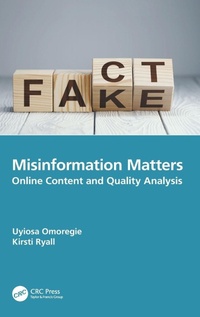
Misinformation Matters
Online Content and Quality Analysis
1st Edition
Published on 19. April 2023
Book
Hardback
100 pages
978-1-032-31155-5 (ISBN)
Description
What is "misinformation"? Why does it matter? How does it spread on the internet, especially on social media platforms? What can we do to counteract the worst of its effects? Can we counteract its effects now that it is ubiquitous? These are the questions we answer in this book. We are living in an information age (specifically an "algorithmic age") which prioritizes information "quantity" over "quality". Social media has brought billions of people from across the world together online and the impact of diverse platforms, such as Facebook, WeChat, Reddit, LinkedIn, Signal, WhatsApp, Gab, Instagram, Telegram, and Snapchat, has been transformational.
The internet was created, with the best of intentions, as an online space where written content could be created, consumed and diffused without any real intermediary. This empowering aspect of the web is still, mostly, a force for good. People, on the whole, are better informed and online discussion is more inclusive because barriers to participation are reduced. As activity online has grown, however, an expanding catalogue of research reveals a darker side to social media, and the internet generally. Namely, misinformation's ability to negatively influence our behaviour both online and offline.
The solution we provide to this growing dilemma is informed by Ludwig Wittgenstein's Tractatus Logico-Philosophicus, which examines the relationship between language and reality from a philosophical perspective, and complements Claude Shannon's Information Quantity Theory, which addresses the quantification, storage and communication of digital information from a mathematical perspective. The book ends by setting out a model designed by us: a "Wittgensteinian" approach to information quality. It defines content published online by clarifying the propositions and claims made within it. Our model's online information quality check allows users to effectively analyse the quality of trending online content. This approach to misinformation analysis and prevention has been designed to be both easy to use and pragmatic. It upholds freedom of speech online while using the "harm principle" to categorise problematic content.
The internet was created, with the best of intentions, as an online space where written content could be created, consumed and diffused without any real intermediary. This empowering aspect of the web is still, mostly, a force for good. People, on the whole, are better informed and online discussion is more inclusive because barriers to participation are reduced. As activity online has grown, however, an expanding catalogue of research reveals a darker side to social media, and the internet generally. Namely, misinformation's ability to negatively influence our behaviour both online and offline.
The solution we provide to this growing dilemma is informed by Ludwig Wittgenstein's Tractatus Logico-Philosophicus, which examines the relationship between language and reality from a philosophical perspective, and complements Claude Shannon's Information Quantity Theory, which addresses the quantification, storage and communication of digital information from a mathematical perspective. The book ends by setting out a model designed by us: a "Wittgensteinian" approach to information quality. It defines content published online by clarifying the propositions and claims made within it. Our model's online information quality check allows users to effectively analyse the quality of trending online content. This approach to misinformation analysis and prevention has been designed to be both easy to use and pragmatic. It upholds freedom of speech online while using the "harm principle" to categorise problematic content.
More details
Language
English
Place of publication
London
United Kingdom
Publishing group
Taylor & Francis Ltd
Target group
College/higher education
Professional and scholarly
General, Professional, and Undergraduate Advanced
Illustrations
4 s/w Abbildungen, 4 s/w Zeichnungen, 2 s/w Tabellen
2 Tables, black and white; 4 Line drawings, black and white; 4 Illustrations, black and white
Dimensions
Height: 240 mm
Width: 161 mm
Thickness: 11 mm
Weight
347 gr
ISBN-13
978-1-032-31155-5 (9781032311555)
Copyright in bibliographic data and cover images is held by Nielsen Book Services Limited or by the publishers or by their respective licensors: all rights reserved.
Schweitzer Classification
Other editions
Additional editions
E-Book
04/2023
1st Edition
CRC Press
€64.49
Available for download
Book
04/2023
1st Edition
CRC Press
€70.50
Shipment within 10-20 days
E-Book
04/2023
1st Edition
CRC Press
€64.49
Available for download
Persons
The authors are the co-founders of Avram Turing, a research organisation focused on misinformation prevention online and content analysis.
Uyiosa Omoregie is the principal analyst at Avram Turing. He attended West Buckland School in England, U.K. He is an alumnus of the University of London (The London School of Economics as lead college). He is a member of the Association of Internet Researchers (AoIR), the Canadian Association for Information Science and the Canadian Academy of Independent Scholars. He is a referee for the Journal of Information Science (SAGE Publishing) and Misinformation Review (Harvard University).
Kirsti Ryall, is the principal researcher at Avram Turing. She attended West Buckland School in England, U.K. She holds a degree in English Literature. She previously worked in advertising, marketing, and fundraising roles as a graphic designer, copywriter, proof-reader, and as a trainer helping others on how best to present their work. She is a member of the Association of Internet Researchers (AoIR).
Uyiosa Omoregie is the principal analyst at Avram Turing. He attended West Buckland School in England, U.K. He is an alumnus of the University of London (The London School of Economics as lead college). He is a member of the Association of Internet Researchers (AoIR), the Canadian Association for Information Science and the Canadian Academy of Independent Scholars. He is a referee for the Journal of Information Science (SAGE Publishing) and Misinformation Review (Harvard University).
Kirsti Ryall, is the principal researcher at Avram Turing. She attended West Buckland School in England, U.K. She holds a degree in English Literature. She previously worked in advertising, marketing, and fundraising roles as a graphic designer, copywriter, proof-reader, and as a trainer helping others on how best to present their work. She is a member of the Association of Internet Researchers (AoIR).
Content
1. Introduction, 2. Background, 3. A Philosophical Approach, 4. Interventions, 5. Analysing the Problem, 6. The Global Online Information Quality Check Model, 7. Conclusion.