

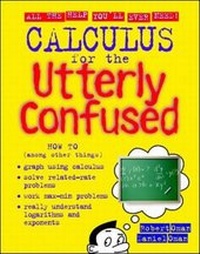
Calculus for the Utterly Confused
70th Edition
Published on 16. August 1998
Book
Paperback/Softback
208 pages
978-0-07-048261-6 (ISBN)
Description
When it comes to understanding one of your most intimidating courses--calculus--even good students can be confused. Intended primarily for the non-engineering calculus student (though the more serious calculus student will also benefit), Calculus for the Utterly Confused is your ticket to success. Calculus concepts are explained and applied in such diverse fields as business, medicine, finance, economics, chemistry, sociology, physics, and health and environmental sciences. The message of Calculus for the Utterly Confused is simple: You donOt have to be confused anymore. With the wealth of expert advice from the authors who have taught many, many confused students, youOll discover a newer, fresher, clearer way to look at calculus. DonOt wait another minute--get on the road to higher grades and greater confidence, and go from utterly confused to totally prepared in no time!
More details
Edition
70th ed.
Language
English
Place of publication
United States
Publishing group
McGraw-Hill Education - Europe
Target group
College/higher education
Dimensions
Height: 231 mm
Width: 183 mm
Thickness: 15 mm
Weight
352 gr
ISBN-13
978-0-07-048261-6 (9780070482616)
Copyright in bibliographic data and cover images is held by Nielsen Book Services Limited or by the publishers or by their respective licensors: all rights reserved.
Schweitzer Classification
Persons
McGraw-Hill authors represent the leading experts in their fields and are dedicated to improving the lives, careers, and interests of readers worldwide
McGraw-Hill authors represent the leading experts in their fields and are dedicated to improving the lives, careers, and interests of readers worldwide
McGraw-Hill authors represent the leading experts in their fields and are dedicated to improving the lives, careers, and interests of readers worldwide
Content
Mathematical Background.Limits and Continuity.Derivatives.Max-Min Problems.Related Rate Problems.Graphing.Integration.Series and Approximations.Differentiation and Integration of Trigonometric Functions.Differentiation and Integration of Exponential and Lorarithmic Functions.