

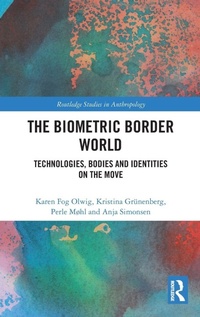
The Biometric Border World
Technology, Bodies and Identities on the Move
1st Edition
Published on 4. November 2019
Book
Hardback
240 pages
978-0-367-19958-6 (ISBN)
Description
Since the 1990s, biometric border control has attained key importance throughout Europe. Employing digital images of, for example, fingerprints, DNA, bones, faces or irises, biometric technologies use bodies to identify, categorize and regulate individuals' cross-border movements.
Based on innovative collaborative fieldwork, this book examines how biometrics are developed, put to use and negotiated in key European border sites. It analyses the disparate ways in which the technologies are applied, perceived and experienced by border control agents and others managing the cross-border flow of people, by scientists and developers engaged in making the technologies, and by migrants and non-government organizations attempting to manoeuvre in the complicated and often-unpredictable systems of technological control.
Biometric technologies are promoted by national and supranational authorities and industry as scientifically exact and neutral methods of identification and verification, and as an infallible solution to security threats. The ethnographic case studies in this volume demonstrate, however, that the technologies are, in fact, characterized by considerable ambiguity and uncertainty and subject to substantial subjective interpretation, translation and brokering with different implications for migrants, border guards, researchers and other actors engaged in the border world.
Based on innovative collaborative fieldwork, this book examines how biometrics are developed, put to use and negotiated in key European border sites. It analyses the disparate ways in which the technologies are applied, perceived and experienced by border control agents and others managing the cross-border flow of people, by scientists and developers engaged in making the technologies, and by migrants and non-government organizations attempting to manoeuvre in the complicated and often-unpredictable systems of technological control.
Biometric technologies are promoted by national and supranational authorities and industry as scientifically exact and neutral methods of identification and verification, and as an infallible solution to security threats. The ethnographic case studies in this volume demonstrate, however, that the technologies are, in fact, characterized by considerable ambiguity and uncertainty and subject to substantial subjective interpretation, translation and brokering with different implications for migrants, border guards, researchers and other actors engaged in the border world.
More details
Series
Language
English
Place of publication
London
United Kingdom
Publishing group
Taylor & Francis Ltd
Target group
College/higher education
Illustrations
34 s/w Photographien bzw. Rasterbilder, 34 s/w Abbildungen
34 Halftones, black and white; 34 Illustrations, black and white
Dimensions
Height: 240 mm
Width: 161 mm
Thickness: 18 mm
Weight
546 gr
ISBN-13
978-0-367-19958-6 (9780367199586)
Copyright in bibliographic data and cover images is held by Nielsen Book Services Limited or by the publishers or by their respective licensors: all rights reserved.
Schweitzer Classification
Other editions
Additional editions
Karen Fog Olwig | Kristina Gruenenberg | Perle Mohl
The Biometric Border World
Technology, Bodies and Identities on the Move
Book
06/2021
1st Edition
Routledge
€67.40
Shipment within 10-20 days
Karen Fog Olwig | Kristina Gruenenberg | Perle Mohl
The Biometric Border World
Technology, Bodies and Identities on the Move
E-Book
10/2019
1st Edition
Routledge
€60.49
Available for download
Karen Fog Olwig | Kristina Gruenenberg | Perle Mohl
The Biometric Border World
Technology, Bodies and Identities on the Move
E-Book
10/2019
1st Edition
Routledge
€60.49
Available for download
Persons
Karen Fog Olwig is Professor in the Department of Anthropology at the University of Copenhagen, Denmark.
Kristina Gruenenberg is Associate Professor in the Department of Anthropology at the University of Copenhagen, Denmark.
Perle Mohl is Researcher at CAMES - Copenhagen Academy for Medical Education and Simulation, Denmark.
Anja Simonsen is Assistant Professor in the Department of Anthropology at the University of Copenhagen, Denmark.
Kristina Gruenenberg is Associate Professor in the Department of Anthropology at the University of Copenhagen, Denmark.
Perle Mohl is Researcher at CAMES - Copenhagen Academy for Medical Education and Simulation, Denmark.
Anja Simonsen is Assistant Professor in the Department of Anthropology at the University of Copenhagen, Denmark.
Content
Introduction; I. In the laboratory; 1. Body Cartographers: Mapping Bodies and Borders in the Laboratory; 2. The 'Biometric Community': Friends, Foes and the Political Economy of Biometric Technologies; II On the border; 3. Vision, Faces, Identities: Technologies of Recognition; 4. 'Is it a donkey?' Presences, Senses and Figuration in Human-technological Border Control; III. En route; 5. Fleeting (biometric) Encounters: Care and Control at Italian border Sites; 6. 'In-formation' and 'Out-formation': Routines and Gaps en route; IV. In the family; 7. Biometric Verification vs. Social Validation of Relations of Kinship: Somali Refugees in Denmark; 8. Mouth Swabs and other Techniques of Verification: Determining Refugees' Rights to a Family Life; Conclusion