

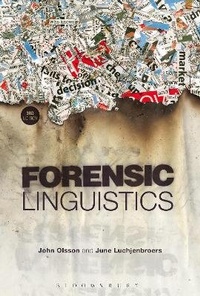
Forensic Linguistics
4th Edition
Published on 5. December 2013
Book
Hardback
368 pages
978-1-4411-8660-7 (ISBN)
Description
Now in its third edition, this practical introduction to forensic linguistics is required reading for students of language and the law. It includes:
new chapters on identifying forensic texts and important interactional aspects of the language used in legal contexts
an additional chapter on forensic phonetics by Harry Hollien, a world renowned forensic phonetician
an appendix of forensic texts for student study, and even more exercises and suggestions for further reading
a companion website with a repository of statements, notes and examples referred to throughout the text.
new chapters on identifying forensic texts and important interactional aspects of the language used in legal contexts
an additional chapter on forensic phonetics by Harry Hollien, a world renowned forensic phonetician
an appendix of forensic texts for student study, and even more exercises and suggestions for further reading
a companion website with a repository of statements, notes and examples referred to throughout the text.
Reviews / Votes
[A]n extremely useful book for students and practitioners in a broad range of fields ... [including] law students, practising lawyers, students of applied linguistics, criminologists [and] police officers ... One of the strengths of the book is that real-life legal cases are referred to when illustrating theoretical points ... [A]n informative and accessible text. * New Zealand Studies in Applied Linguistics * This book is vital reading for students and researchers of forensic linguistics and will undoubtedly help to cement interest in the field. It is stunningly comprehensive, addressing a generous range of forensic-related themes and issues: from cyber-terrorism to suicide notes. It takes in spoken, written and computer-mediated communication, examines, in detail, key studies and cases, and is written in a limpid and engaging style. The book also usefully includes a number of practical exercises and insightful commentaries which will prove invaluable to readers wishing to sharpen their forensic analytical sensibilities. This new edition of Forensic Linguistics is a joy to read, and I will be recommending it to all of my students interested in the interface between language and society. -- Kevin Harvey, Lecturer in Applied Sociolinguistics, University of Nottingham, UKMore details
Edition
4th edition
Language
English
Place of publication
New York
United States
Publishing group
Bloomsbury Publishing Plc
Target group
College/higher education
Professional and scholarly
Dimensions
Height: 234 mm
Width: 156 mm
Weight
683 gr
ISBN-13
978-1-4411-8660-7 (9781441186607)
DOI
CBID167059
Copyright in bibliographic data and cover images is held by Nielsen Book Services Limited or by the publishers or by their respective licensors: all rights reserved.
Schweitzer Classification
Persons
John Olsson was a lecturer in Forensic Linguistics in both the School of Linguistics and the School of Law at Bangor University, Wales, and was head of the Forensic Linguistics Institute. Additionally, he taught forensic linguistics online.
June Luchjenbroers is Senior Lecturer in Linguistics at Bangor University, Wales.
June Luchjenbroers is Senior Lecturer in Linguistics at Bangor University, Wales.
Content
Introduction.
Part I: Language as Forensic Evidence
1. The road to authorship
2. The author constructed
3. Time, variation and genre
4. Range of variation
5. Textual Variation
6. Forensic phonetics
7. Cybercrime
Part Two: Dealing with linguistic Evidence
8. Forensic texts
9. Forensic transcription
10. Forensic authorship in practice
11. Investigating author variation in naturalistic data
12. Forensic linguistic evidence in court
Part Three: The legal process: Language and the law
13. Power in legal contexts: The courts
14. Power in legal contexts: The police
15. Vulnerable witnesses
Part Four: Language of the law
16. The law and us
17. The language of statutes
Appendix 1: Forensic texts
Appendix 2: Exercises and exercise commentaries
Appendix 3: Active researchers in the field of the forensic linguistics
Bibliography
Author Index
Subject Index
Part I: Language as Forensic Evidence
1. The road to authorship
2. The author constructed
3. Time, variation and genre
4. Range of variation
5. Textual Variation
6. Forensic phonetics
7. Cybercrime
Part Two: Dealing with linguistic Evidence
8. Forensic texts
9. Forensic transcription
10. Forensic authorship in practice
11. Investigating author variation in naturalistic data
12. Forensic linguistic evidence in court
Part Three: The legal process: Language and the law
13. Power in legal contexts: The courts
14. Power in legal contexts: The police
15. Vulnerable witnesses
Part Four: Language of the law
16. The law and us
17. The language of statutes
Appendix 1: Forensic texts
Appendix 2: Exercises and exercise commentaries
Appendix 3: Active researchers in the field of the forensic linguistics
Bibliography
Author Index
Subject Index