

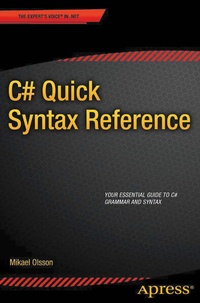
C# Quick Syntax Reference
Published on 31. July 2013
Book
Paperback/Softback
CV, 16 pages
978-1-4302-6280-0 (ISBN)
Description
The C# Quick Syntax Reference is a condensed code and syntax reference to the C# programming language. It presents the essential C# syntax in a well-organized format that can be used as a handy reference.
You won't find any technical jargon, bloated samples, drawn out history lessons or witty stories in this book. What you will find is a language reference that is concise, to the point and highly accessible. The book is packed with useful information and is a must-have for any C# programmer.
In the C# Quick Syntax Reference, you will find:
· A concise reference to the C# language syntax.
· Short, simple and focused code examples.
· A well laid out table of contents and a comprehensive index allowing easy review.
More details
Other editions
Additional editions
Person
Mikael Olsson is a professional web entrepreneur, programmer, and author. He works for an R&D company in Finland where he specializes in software development. In his spare time he writes books and creates websites that summarize various fields of interest. The books he writes are focused on teaching their subject in the most efficient way possible, by explaining only what is relevant and practical without any unnecessary repetition or theory. The portal to his online businesses and other websites is Siforia.com.
Content
1. HelloWorld 2. Compile and Run 3. Variables 4. Operators 5. String 6. Arrays 7. Conditionals 8. Loops 9. Methods 10. Class 11. Inheritance 12. Redefining Members 13. Access Levels 14. Static 15. Properties 16. Indexers 17. Interface 18. Abstract 19. Namespaces 20. Enum 21. Exception Handling 22. Operator Overloading 23. Custom Conversions 24. Constants 25. Preprocessor 26. Delegates 27. Events 28. Generics 29. Struct 30. Asynchronous Methods