

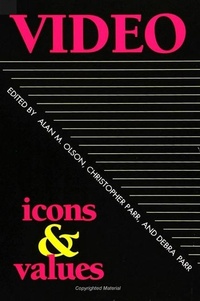
Video Icons & Values
Published on 20. December 1990
Book
Paperback/Softback
198 pages
978-0-7914-0412-6 (ISBN)
Description
This book focuses on the most powerful agency of value formation in our time - the video image as purveyed through television and mass media. Special attention is given to the impact of television on education and the challenges of instructing a generation of children who have never know a time BT, that is, "before television."
Both the negative and the positive implications and consequences of video technology are discussed in the book by a range of experts in the humanities and social sciences. Among the prominent issues and questions: How does television function as an agent of value formation? What is the impact of conventional, commercial format on values and critical judgment? What is a video text and how is it different from a convention text? How do we develop the instructional tools to teach people to be critical viewers? What is television's place in the arts and what is a video artist? What happens to consciousness after viewing 30,000 or more hours of television by the time an individual graduates from high school? Is the growing problem of aliteracy directly attributable to television?
The social and moral implications of television during its "second 50 years" will be profound and far-reaching. The authors of Video Icons and Values provide valuable clues as to what these implications are, will be, and what can be done about them.
Both the negative and the positive implications and consequences of video technology are discussed in the book by a range of experts in the humanities and social sciences. Among the prominent issues and questions: How does television function as an agent of value formation? What is the impact of conventional, commercial format on values and critical judgment? What is a video text and how is it different from a convention text? How do we develop the instructional tools to teach people to be critical viewers? What is television's place in the arts and what is a video artist? What happens to consciousness after viewing 30,000 or more hours of television by the time an individual graduates from high school? Is the growing problem of aliteracy directly attributable to television?
The social and moral implications of television during its "second 50 years" will be profound and far-reaching. The authors of Video Icons and Values provide valuable clues as to what these implications are, will be, and what can be done about them.
Reviews / Votes
"The strong point of this book is that it is extraordinarily well written. The literature base that it operates from is literary criticism, and philosophy, a very fertile approach. The problem or topic is very important; it is a response to the Bloom and Hirsch criticism of American Culture. How can we retrieve a historically based culture from the onslaught of irreverence of chronology, or the cultural depth of its references?" - Charles Simpson, State University of New York, PlattsburgMore details
Language
English
Place of publication
Albany, NY
United States
Target group
Professional and scholarly
US School Grade: College Graduate Student and over
Product notice
Paperback (trade)
Dimensions
Height: 229 mm
Width: 152 mm
Thickness: 25 mm
Weight
327 gr
ISBN-13
978-0-7914-0412-6 (9780791404126)
Copyright in bibliographic data and cover images is held by Nielsen Book Services Limited or by the publishers or by their respective licensors: all rights reserved.
Schweitzer Classification
Persons
At Boston University, Alan M. Olson is Chairman ad interim, of the Department of Philosophy, and author of Hegel and the Spirit: Philosophy as Pneumatology. Christopher Parr is a New Zealand poet doing research in Religion and Literature. Debra Parr is researcher on modern and postmodern American landscapes in the Department of English.
Content
Acknowledgments
1. Video Icons & Values: An Overview
Alan M. Olson
2. Video Ergo Sum
Jeremy Murray-Brown
3. Television and the Shaping of Cognitive Skills
Renee Hobbs
4. The Emperor Has Only Clothes: Toward a Hermeneutic of the Video Text
Lenore Langsdorf
5. The Electronic Golden Calf
Gregor Goethals
6. Power and Pleasure in Video Texts
Robert Scholes
7. In Video Veritas: The Mythic Structures of Video Dynamics
E. David Thorp
8. Selling Out Max Headroom
Rebecca L. Abbott
9. What is "Soul"?
Dick Hebdige
10. An Afterword: Beyond Lamentation
Christopher and Debra Parr
Notes
Selected Bibliography
Contributors
Index
1. Video Icons & Values: An Overview
Alan M. Olson
2. Video Ergo Sum
Jeremy Murray-Brown
3. Television and the Shaping of Cognitive Skills
Renee Hobbs
4. The Emperor Has Only Clothes: Toward a Hermeneutic of the Video Text
Lenore Langsdorf
5. The Electronic Golden Calf
Gregor Goethals
6. Power and Pleasure in Video Texts
Robert Scholes
7. In Video Veritas: The Mythic Structures of Video Dynamics
E. David Thorp
8. Selling Out Max Headroom
Rebecca L. Abbott
9. What is "Soul"?
Dick Hebdige
10. An Afterword: Beyond Lamentation
Christopher and Debra Parr
Notes
Selected Bibliography
Contributors
Index