

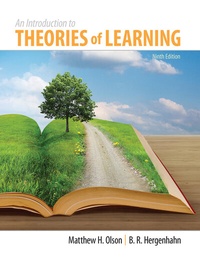
An Introduction to Theories of Learning
Ninth Edition
9th Edition
Published on 15. July 2012
Book
Hardback
480 pages
978-0-205-87186-5 (ISBN)
Description
Defines learning and shows how the learning process is studied. Clearly written and user-friendly, Introduction to the Theories of Learning places learning in its historical perspective and provides appreciation for the figures and theories that have shaped 100 years of learning theory research. The 9th edition has been updated with the most current research in the field. With Pearson's MySearchLab with interactive eText and Experiment's Tool, this program is more user-friendly than ever. Learning Goals Upon completing this book, readers should be able to: Define learning and show how the learning process is studied Place learning theory in historical perspective Present essential features of the major theories of learning with implications for educational practice Note: MySearchLab does not come automatically packaged with this text. To purchase MySearchLab, please visit: www.mysearchlab.com or you can purchase a ValuePack of the text + MySearchLab (at no additional cost).
More details
Other editions
Additional editions
E-Book
07/2015
9th Edition
Routledge
€160.99
Available for download

Book
07/2012
9th Edition
Routledge
€185.69
Article not available for order
Previous edition
Book
06/2008
8th Edition
Routledge
Unfortunately, price unknown
No shipping information available
Person
Content
Part 1: Introduction to Learning, 1. What Is Learning?, 2. Approaches to the Study of Learning, 3. Early Notions about Learning, Part 2: Predominantly Functionalistic Theories, 4. Edward Lee Thorndike, 5. Burrhus Frederick Skinner, 6. Clark Leonard Hull, Part 3: Predominantly Associationistic Theories, 7. Ivan Petrovich Pavlov, 8. Edwin Ray Guthrie, 9. William Kaye Estes, Part 4: Predominantly Cognitive Theories, 10. Gestalt Theory, 11. Jean Piaget, 12. Edward Chace Tolman, 13. Albert Bandura, Part 5: A Predominantly Neurophysiological Theory, 14. Donald Olding Hebb, Part 6: An Evolutionary Theory, 15. Robert C. Bolles and Evolutionary Psychology, Part 7: Some Final Thoughts, 16. A Final Word 17. Glossary