

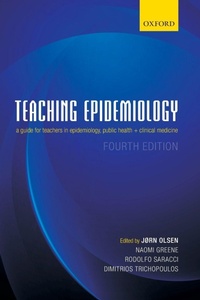
Teaching Epidemiology
A guide for teachers in epidemiology, public health and clinical medicine
4th Edition
Published on 26. March 2015
Book
Paperback/Softback
576 pages
978-0-19-968500-4 (ISBN)
Description
Teaching epidemiology requires skill and knowledge, combined with a clear teaching strategy and good pedagogic skills. The general advice is simple: if you are not an expert on a topic, try to enrich your background knowledge before you start teaching. The new edition of Teaching Epidemiology helps you to do this and, by providing world-expert teachers' advice on how best to structure teaching, providing a unique insight into what has worked in their hands. This book will help you to tailor your own epidemiology teaching programme.
The fourth edition of this established text has been fully revised and updated, drawing on new research findings and recently developed methods including research technologies in genetic epidemiology and method development in relation to causal analysis. Analytical tools provide teachers in the field with the skills to guide students at both undergraduate and postgraduate levels. Each chapter in Teaching Epidemiology comprises key concepts in epidemiology, subject specific methodologies, and disease specific issues, to provide expert assistance in the teaching of a wide range of epidemiology courses.
The fourth edition of this established text has been fully revised and updated, drawing on new research findings and recently developed methods including research technologies in genetic epidemiology and method development in relation to causal analysis. Analytical tools provide teachers in the field with the skills to guide students at both undergraduate and postgraduate levels. Each chapter in Teaching Epidemiology comprises key concepts in epidemiology, subject specific methodologies, and disease specific issues, to provide expert assistance in the teaching of a wide range of epidemiology courses.
More details
Edition
4th Revised edition
Language
English
Place of publication
Oxford
United Kingdom
Target group
Professional and scholarly
Edition type
Revised edition
Dimensions
Height: 234 mm
Width: 156 mm
Thickness: 30 mm
Weight
854 gr
ISBN-13
978-0-19-968500-4 (9780199685004)
Copyright in bibliographic data and cover images is held by Nielsen Book Services Limited or by the publishers or by their respective licensors: all rights reserved.
Schweitzer Classification
Other editions
Additional editions
Jørn Olsen | Naomi Greene | Rodolfo Saracci
Teaching Epidemiology
A guide for teachers in epidemiology, public health and clinical medicine
E-Book
03/2015
4th Edition
OUP eBook
€60.49
Available for download
J. Olsen | Naomi Greene
Teaching Epidemiology: A Guide for Teachers in Epidemiology, Public Health and Clinical Medicine
A guide for teachers in epidemiology, public health and clinical medicine
E-Book
01/2015
Oxford University Press, USA
€60.49
Available for download
Previous edition
Jorn Olsen
Teaching Epidemiology
A guide for teachers in epidemiology, public health and clinical medicine
Book
04/2010
3rd Edition
Oxford University Press
€55.70
Article exhausted; check for reprint
Persons
Jorn Olsen is Professor of Epidemiology at AU, SDU and UCLA. Have published books and articles in several fields of epidemiology but most of the work has been in reproductive health.
Naomi Greene holds a Ph.D in Epidemiology and MPH in Community Health Sciences from the UCLA Fielding School of Public Health. She has an extensive clinical background in maternal and child health which guides her research interest in lifecourse epidemiology and the Developmental Origins of Health and Disease.
Dimitrios Trichopoulos MD, PhD, is Professor of Cancer Prevention and Professor of Epidemiology at the Harvard School of Public Health. He is Member of the Athens Academy and President of the Hellenic Health Foundation, Greece. He has served as director of the Harvard Center for Cancer Prevention; chairman of the Epidemiology Departments at the University of Athens and at Harvard; and adjunct professor of medical epidemiology at the Karolinska Institute in Sweden. Dr. Trichopoulos has received several awards and distinctions, including honorary Doctorates, the Brinker International Award for Breast Cancer Clinical Research, the Julius Richmond Award, and the Medal of Honor of the International Agency for Research on Cancer.
Naomi Greene holds a Ph.D in Epidemiology and MPH in Community Health Sciences from the UCLA Fielding School of Public Health. She has an extensive clinical background in maternal and child health which guides her research interest in lifecourse epidemiology and the Developmental Origins of Health and Disease.
Dimitrios Trichopoulos MD, PhD, is Professor of Cancer Prevention and Professor of Epidemiology at the Harvard School of Public Health. He is Member of the Athens Academy and President of the Hellenic Health Foundation, Greece. He has served as director of the Harvard Center for Cancer Prevention; chairman of the Epidemiology Departments at the University of Athens and at Harvard; and adjunct professor of medical epidemiology at the Karolinska Institute in Sweden. Dr. Trichopoulos has received several awards and distinctions, including honorary Doctorates, the Brinker International Award for Breast Cancer Clinical Research, the Julius Richmond Award, and the Medal of Honor of the International Agency for Research on Cancer.
Editor
, Professor and Former Chair of the Department of Epidemiology, UCLA School of Public Heath, California, USA and Professor, University of Aarhus, Denmark
Assistant ResearcherAssistant Researcher, Department of Epidemiology, Fielding School of Public Health, University of California, Los Angeles
, Director of Research in Epidemiology, National Council, Pisa, Italy; Adjunct Professor of Epidemiology, University of Aarhus, Denmark and Scientific Consultant, International Agency for Research on Cancer (IARC), Lyon, France
Vincent L. Gregory Professor of Cancer Prevention and Professor of EpidemiologyVincent L. Gregory Professor of Cancer Prevention and Professor of Epidemiology, Harvard School of Public Health, Boston, USA
Content
PART 1: CONTEXT; PART 2: EXPOSURE-ORIENTED EPIDEMIOLOGY; PART 3: OUTCOME-ORIENTED EPIDEMIOLOGY; PART 4: PEDAGOGIES