

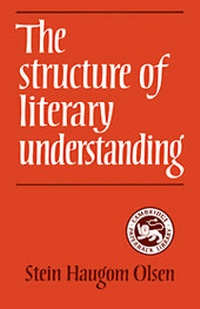
The Structure of Literary Understanding
Published on 13. April 1978
Book
Hardback
240 pages
978-0-521-21731-6 (ISBN)
Description
How does a reader respond to a work of literature and how does he begin to evaluate it? Mr Olsen attempts to answer these and related questions. The book is in two parts. In the first three chapters, the author demolishes established theories that literature has a special language, provides a heightened insight into 'truth' and has emotion as its prime currency. In the remaining chapters Mr Olsen constructs and fully illustrates the theory that understanding of a work of literature comes in two complementary stages: first, judgements about the author's aesthetic intentions (interpretation); second, appreciation of the aesthetic qualities of the work (evaluation). At the end of his argument, attempting an answer to the question 'Why is literature important?', Mr Olsen characterizes literature as an institution and thus forges links with contemporary philosophy which sees all human action as ordered and defined by social institutions.
More details
Language
English
Place of publication
Cambridge
United Kingdom
Target group
College/higher education
Dimensions
Height: 216 mm
Width: 138 mm
Weight
440 gr
ISBN-13
978-0-521-21731-6 (9780521217316)
Copyright in bibliographic data and cover images is held by Nielsen Book Services Limited or by the publishers or by their respective licensors: all rights reserved.
Schweitzer Classification
Other editions
New editions
Stein Haugom Olsen
The Structure of Literary Understanding
Book
02/1985
Cambridge University Press
€57.00
Shipment within 15-20 days
Additional editions
Stein Haugom Olsen
The Structure of Literary Understanding
Book
02/1985
Cambridge University Press
€57.00
Shipment within 15-20 days
Content
1. Literature and Language; 2. Literature and Emotion; 3. Literature and Truth; 4. The Structure of the Literary Response; 5. The Validation of Interpretative Conclusions; 6. Evaluation of Literary Works; 7. The Evaluation of Literary Practice.