

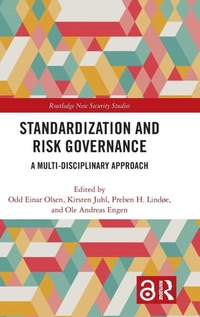
Standardization and Risk Governance
A Multi-Disciplinary Approach
1st Edition
Published on 11. November 2019
Book
Hardback
290 pages
978-0-367-25973-0 (ISBN)
Description
This multi-disciplinary book conceptualizes, maps, and analyses ongoing standardization processes of risk issues across various sectors, processes, and practices.
Standards are not only technical specifications and guidelines to support efficient risk governance, but also contain social, political, economic, and organizational aspects. This book presents a variety of standardization processes and applications of standards that may influence our judgements of risk, the organizing of risk governance, and, accordingly, our behaviour. Standardization and standards can impact risk governance in different ways. The most important lessons drawn from the present volume can be summarized in three areas: (1) how standardization might impact on power relations and interests; (2) how standardization may change flexibility in decision-making, communication, and cooperation; and (3) how standardization could (re)direct attention and risk perception.
The volume's aim is to present an analysis of standardization processes and how it affects our thinking about risk, how we organize risk governance, and how standardization may influence risk management. In so doing, it contributes to a more informed discourse regarding the use of standards and standardization in contemporary risk management.
Standardization and Risk Governance will be of great interest to students of risk, standardization, global governance, and critical security studies.
The Open Access version of this book, available at: https://www.taylorfrancis.com/books/e/9780429290817, has been made available under a Creative Commons Attribution-Non Commercial-No Derivatives 4.0 license
Standards are not only technical specifications and guidelines to support efficient risk governance, but also contain social, political, economic, and organizational aspects. This book presents a variety of standardization processes and applications of standards that may influence our judgements of risk, the organizing of risk governance, and, accordingly, our behaviour. Standardization and standards can impact risk governance in different ways. The most important lessons drawn from the present volume can be summarized in three areas: (1) how standardization might impact on power relations and interests; (2) how standardization may change flexibility in decision-making, communication, and cooperation; and (3) how standardization could (re)direct attention and risk perception.
The volume's aim is to present an analysis of standardization processes and how it affects our thinking about risk, how we organize risk governance, and how standardization may influence risk management. In so doing, it contributes to a more informed discourse regarding the use of standards and standardization in contemporary risk management.
Standardization and Risk Governance will be of great interest to students of risk, standardization, global governance, and critical security studies.
The Open Access version of this book, available at: https://www.taylorfrancis.com/books/e/9780429290817, has been made available under a Creative Commons Attribution-Non Commercial-No Derivatives 4.0 license
More details
Series
Language
English
Place of publication
London
United Kingdom
Publishing group
Taylor & Francis Ltd
Target group
College/higher education
Professional and scholarly
Academic, Postgraduate, Professional, and Undergraduate
Illustrations
19 s/w Abbildungen, 2 s/w Photographien bzw. Rasterbilder, 17 s/w Zeichnungen, 2 s/w Tabellen
2 Tables, black and white; 17 Line drawings, black and white; 2 Halftones, black and white; 19 Illustrations, black and white
Dimensions
Height: 240 mm
Width: 161 mm
Thickness: 21 mm
Weight
628 gr
ISBN-13
978-0-367-25973-0 (9780367259730)
Copyright in bibliographic data and cover images is held by Nielsen Book Services Limited or by the publishers or by their respective licensors: all rights reserved.
Schweitzer Classification
Other editions
Additional editions
Odd Einar Olsen | Kirsten Juhl | Preben H. Lindoe
Standardization and Risk Governance
A Multi-Disciplinary Approach
Book
10/2024
1st Edition
Routledge
€68.27
Shipment within 10-20 days
Odd Einar Olsen | Kirsten Juhl | Preben H. Lindoe
Standardization and Risk Governance
A Multi-Disciplinary Approach
E-Book
11/2019
1st Edition
Routledge
€0.00
Available for download
Odd Einar Olsen | Kirsten Juhl | Preben H. Lindoe
Standardization and Risk Governance
A Multi-Disciplinary Approach
E-Book
11/2019
1st Edition
Routledge
€0.00
Available for download
Persons
Odd Einar Olsen is Professor in Risk Management and Societal Safety at the University of Stavanger, Norway.
Kirsten Juhl is Associate Professor in Risk Management and Societal Safety at the University of Stavanger, Norway.
Preben H. Lindoe is Emeritus Professor in Risk Management and Societal Safety at the University of Stavanger, Norway.
Ole Andreas Engen is Professor in Risk Management and Societal Safety at the University of Stavanger, Norway.
Kirsten Juhl is Associate Professor in Risk Management and Societal Safety at the University of Stavanger, Norway.
Preben H. Lindoe is Emeritus Professor in Risk Management and Societal Safety at the University of Stavanger, Norway.
Ole Andreas Engen is Professor in Risk Management and Societal Safety at the University of Stavanger, Norway.
Content
Foreword Odd Einar Olsen, Kirsten Juhl, Preben Hempel Lindoe and Ole Andreas Engen Section I: Introduction 1. The standardization of risk governance Odd Einar Olsen 2. Standardization of risk versus the risk of standardization. A conceptual analysis Kirsten Juhl Section II: Standardization of risk management 3. Towards a standardization of EU disaster risk management? Claudia Morsut 4. Standardization of disaster risk management- Challenges and opportunities Henrik Tehler, Marcus Abrahamsson, Henrik Hassel and Peter Mansson 5. Explosive remnants in Swedish Society- Standardization to visualize a complex risk picture Fredrik Johnsson 6. Which crisis? The promise of standardized risk ranking in the field of EU infectious disease control Louise Bengtsson 7. Standardization and flexibility in surgical operations- A question of balancing risk Sindre Aske Hoyland Section III: Impact of standardization processes 8. Pre-crime and standardization of security risks Sirpa Virta 9. Standardization of terrorism risk analysis- A means or an obstacle to achieving security? Sissel H. Jore 10. Standardization of cybersecurity for critical infrastructures- The role of sensemaking and translation Ruth Ostgaard Skotnes 11. Standardizations and risk mapping- Strengths and weaknesses Lene Jorgensen and Preben H. Lindoe Section IV: Standardization of risk in business activity 12. Standardization, risk dispersion, and trading Grahame F. Thompson 13. UN guiding principles on business and human rights Ian Higham 14. The role of standards in hard and soft approaches to safety regulation Preben H. Lindoe and Michael S. Baram 15. Consensus and conflicts. Tripartite model and standardisation in the Norwegian petroleum industry Ole Andreas Engen 16. Dilemmas of standardization in risk governance Odd Einar Olsen