

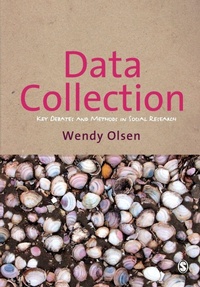
Data Collection
Key Debates and Methods in Social Research
1st Edition
Published on 4. November 2011
Book
Paperback/Softback
248 pages
978-1-84787-256-2 (ISBN)
Description
This innovative book provides students and researchers alike with an indispensible introduction to the key theoretical issues and practical methods needed for data collection.
It uses clear definitions, relevant interdisciplinary examples from around the world and up-to-date suggestions for further reading to demonstrate how to usefully gather and use qualitative, quantitative, and mixed data sets.
The book is divided into seven critical parts:
* Data Collection: An Introduction to Research Practices
* Collecting Qualitative Data
* Observation and Informed Methods
* Experimental and Systematic Data Collection
* Survey Methods for Data Collection
* The Case Study Method of Data Collection
* Concluding Suggestions for Data Collection Groups
A stimulating, practical guide which can be read as individual concepts or as a whole this will be an important resource for students and research professionals.
Wendy Olsen is Senior Lecturer at Manchester University, Institute for Development Policy & Management and Cathie Marsh Centre for Census & Survey Research
It uses clear definitions, relevant interdisciplinary examples from around the world and up-to-date suggestions for further reading to demonstrate how to usefully gather and use qualitative, quantitative, and mixed data sets.
The book is divided into seven critical parts:
* Data Collection: An Introduction to Research Practices
* Collecting Qualitative Data
* Observation and Informed Methods
* Experimental and Systematic Data Collection
* Survey Methods for Data Collection
* The Case Study Method of Data Collection
* Concluding Suggestions for Data Collection Groups
A stimulating, practical guide which can be read as individual concepts or as a whole this will be an important resource for students and research professionals.
Wendy Olsen is Senior Lecturer at Manchester University, Institute for Development Policy & Management and Cathie Marsh Centre for Census & Survey Research
Reviews / Votes
'Good data collection is the foundation on which good research is built, but most texts in social research methods focus more on data analysis than the many issues involved in obtaining the data to analyze. Wendy Olsen's lively and wide-ranging work does much to fill the gap' -W. Paul Vogt
, Professor of Research Methods and Evaluation, Illinois State University
'Written with freshness and energy, with copious examples drawn from research in the UK, USA, India and South Africa, this lively guide to data collection includes excellent sections often under-played by methods textbooks, such as the comparative method; data cleaning; survey weights; and secondary analysis. The seriousness and mission of the dedicated researcher shines through its approachable narrative, providing an outstanding example of what a balanced mixed methods perspective has to offer'
Geoff Payne
Professor of Sociology, Newcastle University, UK
More details
Language
English
Place of publication
London
United Kingdom
Target group
College/higher education
Dimensions
Height: 244 mm
Width: 170 mm
Thickness: 14 mm
Weight
438 gr
ISBN-13
978-1-84787-256-2 (9781847872562)
Copyright in bibliographic data and cover images is held by Nielsen Book Services Limited or by the publishers or by their respective licensors: all rights reserved.
Schweitzer Classification
Other editions
Additional editions
Book
11/2011
1st Edition
SAGE Publications Ltd
€221.35
Shipment within 15-20 days
E-Book
11/2011
1st Edition
SAGE Publications Ltd
from
€72.19
Available for download
Person
Wendy Olsen is Senior Lecturer at Manchester University, Institute for Development Policy & Management
and Cathie Marsh Centre for Census & Survey Research.
and Cathie Marsh Centre for Census & Survey Research.
Content
PART ONE: DATA COLLECTION: AN INTRODUCTION TO RESEARCH PRACTICES
Research and Data Collection
Findings
Data
Causes
Sampling
Further Reading for Part One
PART TWO: COLLECTING QUALITATIVE DATA
Interviews
Transcripts
Coding
Meaning
Interpretation
Observer Bias
Representations
Focus Groups
Document Analysis
Accuracy
Ethical Clearance
Further Reading for Part Two
PART THREE: OBSERVATION AND INVOLVED METHODS
Participation
Praxis
Action Research
Observation Methods
Online Data Collection
Further Reading for Part Three
PART FOUR: EXPERIMENTAL AND SYSTEMATIC DATA COLLECTION
Questionnaire Design
Handling Treatment Data
The Ethics of Volunteers
Market-Research Techniques
Creating Systematic Case Study Data
Further Reading for Part Four
PART FIVE: SURVEY METHODS FOR DATA COLLECTION
Operationalisation
Measurement
Causality
Data Cleaning
Data Extraction
Outliers
Subsetting of Data
Survey Weights
Further Reading for Part Five
PART SIX: THE CASE STUDY METHOD OF DATA COLLECTION
Case Study Research
Comparative Research
Configurations
Contingency
Causal Mechanisms
Further Reading for Part Six
PART SEVEN: CONCLUDING SUGGESTIONS ABOUT DATA COLLECTION CONCEPTS
Facts
Reality
Retroduction
Further Reading for Part Seven
Research and Data Collection
Findings
Data
Causes
Sampling
Further Reading for Part One
PART TWO: COLLECTING QUALITATIVE DATA
Interviews
Transcripts
Coding
Meaning
Interpretation
Observer Bias
Representations
Focus Groups
Document Analysis
Accuracy
Ethical Clearance
Further Reading for Part Two
PART THREE: OBSERVATION AND INVOLVED METHODS
Participation
Praxis
Action Research
Observation Methods
Online Data Collection
Further Reading for Part Three
PART FOUR: EXPERIMENTAL AND SYSTEMATIC DATA COLLECTION
Questionnaire Design
Handling Treatment Data
The Ethics of Volunteers
Market-Research Techniques
Creating Systematic Case Study Data
Further Reading for Part Four
PART FIVE: SURVEY METHODS FOR DATA COLLECTION
Operationalisation
Measurement
Causality
Data Cleaning
Data Extraction
Outliers
Subsetting of Data
Survey Weights
Further Reading for Part Five
PART SIX: THE CASE STUDY METHOD OF DATA COLLECTION
Case Study Research
Comparative Research
Configurations
Contingency
Causal Mechanisms
Further Reading for Part Six
PART SEVEN: CONCLUDING SUGGESTIONS ABOUT DATA COLLECTION CONCEPTS
Facts
Reality
Retroduction
Further Reading for Part Seven