

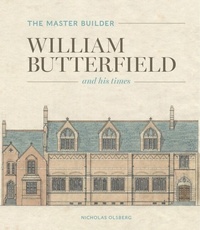
The Master Builder
William Butterfield and His Times
Published on 10. October 2024
Book
Hardback
432 pages
978-1-84822-371-4 (ISBN)
Description
William Butterfield was the most daring, rigorous and brilliant architect of his age, whose 60-year practice spanned the entire Victorian era.
This book addresses the emergence of a modern society, with rapidly expanding new institutions and a changing moral code and explores how Butterfield responded to and advanced that transformation. It reflects the changing emphasis of Butterfield's work: first, the revival, rebuilding and reform of the country parish; next the role of the church and the agents of social health in the burgeoning town and city; third, the revolution in secondary education and college life; and finally, sites of refuge, sanctuary, repose and remembrance. Drawing extensively on the literature of the time, each chapter discusses a societal shift and surveys Butterfield's most important architectural contributions to this. Woven through the book are characterisations of the often colourful men and women who were Butterfield's patrons and associates.
It not only provides in-depth analyses of seminal projects such as All Saint's Margaret Street, Keble College, and Rugby School, along with lesser known, but equally influential works such as Exeter Grammar School, but it also shows how Butterfield through his wide range of work created whole new typologies of buildings - from hospitals and care homes, to seaside resorts, urban schools and working men's colleges, to the Coleridge's great country house in Devon and the village parsonages, cottages and schools in which the characteristics of the Arts and Craft movement first appeared.
This book addresses the emergence of a modern society, with rapidly expanding new institutions and a changing moral code and explores how Butterfield responded to and advanced that transformation. It reflects the changing emphasis of Butterfield's work: first, the revival, rebuilding and reform of the country parish; next the role of the church and the agents of social health in the burgeoning town and city; third, the revolution in secondary education and college life; and finally, sites of refuge, sanctuary, repose and remembrance. Drawing extensively on the literature of the time, each chapter discusses a societal shift and surveys Butterfield's most important architectural contributions to this. Woven through the book are characterisations of the often colourful men and women who were Butterfield's patrons and associates.
It not only provides in-depth analyses of seminal projects such as All Saint's Margaret Street, Keble College, and Rugby School, along with lesser known, but equally influential works such as Exeter Grammar School, but it also shows how Butterfield through his wide range of work created whole new typologies of buildings - from hospitals and care homes, to seaside resorts, urban schools and working men's colleges, to the Coleridge's great country house in Devon and the village parsonages, cottages and schools in which the characteristics of the Arts and Craft movement first appeared.
Reviews / Votes
~ Shortlisted for the 2025 Berger Prize ~(Awarded by the Walpole Society through the generosity of the Berger Collection Educational Trust). 'It is wonderful that Butterfield's achievements have been gathered together and celebrated in this richly rewarding book, written with such sensitivity, attentiveness and intelligence.' - Julian Girdham, teacher and writer 'a magnificent achievement' - Timothy Brittain-Catlin, World of Interiors 'Olsberg illustrates his book with 'a wealth of original drawings and newly commissioned photographs, showing off the master's work in a glorious compendium of colourful visual delights.' - James Stevens Curl, The Critic 'A masterpiece. Brings the man totally alive solely through his work.' - Professor Nicholas Allen, Vienna
More details
Language
English
Place of publication
London
United Kingdom
Illustrations
Illustrations; 270 Illustrations, color; 157 Illustrations, black and white
Dimensions
Height: 290 mm
Width: 252 mm
Thickness: 40 mm
Weight
2560 gr
ISBN-13
978-1-84822-371-4 (9781848223714)
Copyright in bibliographic data and cover images is held by Nielsen Book Services Limited or by the publishers or by their respective licensors: all rights reserved.
Schweitzer Classification
Person
Nicholas Olsberg was Director of the Canadian Centre for Architecture, Montreal and founding Head of Special Collections at the Getty Research Institute. He holds an honours degree in Modern History from Oxford University and a doctorate in Nineteenth Century History from the University of South Carolina. He has written books on the work of Herzog DeMeuron, Carlo Scarpa, John Lautner, Cliff May and Arthur Erickson and been a columnist for the Architectural Review and Building Design.
Content
Prologue. 1. Past and Present. 2. Parochialia. 3. The heath, the Altar and the Grave. 4. Our Overgrown Towns. 5. The Way We Live Now. 6. Character Building. 7. Fellowship, Discipline, Duty. 8. Refuge, Refreshment, Repose. Bibliography. Index.