

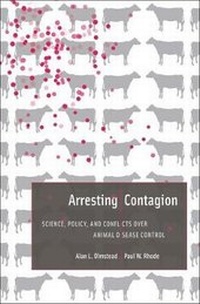
Arresting Contagion
Science, Policy, and Conflicts over Animal Disease Control
Published on 9. February 2015
Book
Hardback
480 pages
978-0-674-72877-6 (ISBN)
Description
Over sixty percent of all infectious human diseases, including tuberculosis, influenza, cholera, and hundreds more, are shared with other vertebrate animals. Arresting Contagion tells the story of how early efforts to combat livestock infections turned the United States from a disease-prone nation into a world leader in controlling communicable diseases. Alan Olmstead and Paul Rhode show that many innovations devised in the fight against animal diseases, ranging from border control and food inspection to drug regulations and the creation of federal research labs, provided the foundation for modern food safety programs and remain at the heart of U.S. public health policy.
America's first concerted effort to control livestock diseases dates to the founding of the Bureau of Animal Industry (BAI) in 1884. Because the BAI represented a milestone in federal regulation of commerce and industry, the agency encountered major jurisdictional and constitutional obstacles. Nevertheless, it proved effective in halting the spread of diseases, counting among its early breakthroughs the discovery of Salmonella and advances in the understanding of vector-borne diseases.
By the 1940s, government policies had eliminated several major animal diseases, saving hundreds of thousands of lives and establishing a model for eradication that would be used around the world. Although scientific advances played a key role, government interventions did as well. Today, a dominant economic ideology frowns on government regulation of the economy, but the authors argue that in this case it was an essential force for good.
America's first concerted effort to control livestock diseases dates to the founding of the Bureau of Animal Industry (BAI) in 1884. Because the BAI represented a milestone in federal regulation of commerce and industry, the agency encountered major jurisdictional and constitutional obstacles. Nevertheless, it proved effective in halting the spread of diseases, counting among its early breakthroughs the discovery of Salmonella and advances in the understanding of vector-borne diseases.
By the 1940s, government policies had eliminated several major animal diseases, saving hundreds of thousands of lives and establishing a model for eradication that would be used around the world. Although scientific advances played a key role, government interventions did as well. Today, a dominant economic ideology frowns on government regulation of the economy, but the authors argue that in this case it was an essential force for good.
Reviews / Votes
Arresting Contagion is...a penetrating glimpse into the behavioral economics that defined early animal disease control efforts in the United States...In their book, Olmstead and Rhode probe the motives that drive individuals to comply with, or reject, efforts to mitigate animal disease transmission. These motives are both fascinating and, more often than not, uncomfortably predictable...Will [be] useful to those who are grappling with the recent resurgence in zoonotic diseases brought about by the rapid expansion of the livestock sector in developing countries and elsewhere. -- Delia Grace * Science * Economists Olmstead and Rhode present an absorbing, detailed account of the often tumultuous history of the Bureau of Animal Industry (BAI), which was formed in 1884 to help stem the tide of contagious livestock diseases. The authors emphasize the many stumbling blocks the BAI encountered implementing this mandate, its eventual eradication of several high-profile diseases, and the overall status of meat inspection/food safety programs and animal disease control infrastructure during the late 19th and early 20th centuries. This well written, fully researched, eye-opening account will be valuable to anyone interested in livestock production, animal disease control, agricultural economics, veterinary medical history, public health, and historical aspects of interstate commerce. -- D. A. Brass * Choice * Anyone who believes that privatization and markets are the solution to all problems should read this book. Olmstead and Rhode make a brilliant case that federal government regulation was necessary to curb devastating animal diseases, that the benefits of regulation for the livestock industry in the U.S. many times outweighed the costs, and that these efforts had substantial health benefits for humans as well. -- Naomi R. Lamoreaux, Yale University A remarkable book on a subject underpinning all aspects of contemporary livestock agricultural sciences and livestock veterinary medicine in the United States. It covers the history of the impact of the animal and zoonotic diseases that have had great economic and public health significance in the era of the rise of commercial agricultural industries and the rise of our food safety infrastructure. It poses a critical question: What about the future? How shall we deal with emerging problems that seem so much more complex than those of the past? -- Frederick A. Murphy, University of Texas Medical BranchMore details
Language
English
Place of publication
Cambridge, Mass
United States
Target group
Professional and scholarly
Illustrations
15 Karten
15 Maps
Dimensions
Height: 235 mm
Width: 156 mm
ISBN-13
978-0-674-72877-6 (9780674728776)
Copyright in bibliographic data and cover images is held by Nielsen Book Services Limited or by the publishers or by their respective licensors: all rights reserved.
Schweitzer Classification
Other editions
Additional editions
E-Book
02/2015
1st Edition
Harvard University Press
€82.09
Available for download
Persons
Alan L. Olmstead is Distinguished Research Professor of Economics at the University of California, Davis. Paul W. Rhode is Professor of Economics at the University of Michigan.