

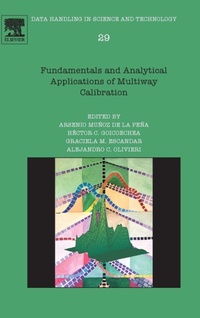
Fundamentals and Analytical Applications of Multiway Calibration: Volume 29
Published on 7. August 2015
Book
Hardback
618 pages
978-0-444-63527-3 (ISBN)
Description
Fundamentals and Analytical Applications of Multi-Way Calibration presents researchers with a set of effective tools they can use to obtain the maximum information from instrumental data. It includes the most advanced techniques, methods, and algorithms related to multi-way calibration and the ways they can be applied to solve actual analytical problems.
This book provides a comprehensive coverage of the main aspects of multi-way analysis, including fundamentals and selected applications of chemometrics that can resolve complex analytical chemistry problems through the use of multi-way calibration.
This book provides a comprehensive coverage of the main aspects of multi-way analysis, including fundamentals and selected applications of chemometrics that can resolve complex analytical chemistry problems through the use of multi-way calibration.
More details
Series
Language
English
Place of publication
Oxford
United Kingdom
Publishing group
Elsevier Science & Technology
Target group
Professional and scholarly
Product notice
Laminated cover
Dimensions
Height: 229 mm
Width: 152 mm
Thickness: 38 mm
Weight
1064 gr
ISBN-13
978-0-444-63527-3 (9780444635273)
Copyright in bibliographic data and cover images is held by Nielsen Book Services Limited or by the publishers or by their respective licensors: all rights reserved.
Schweitzer Classification
Other editions
Additional editions
E-Book
08/2015
Elsevier
€143.00
Available for download
Persons
Alejandro Olivieri was born in Rosario, Argentina, on July 28, 1958. He obtained his B.Sc. in Industrial Chemistry from the Catholic Faculty of Chemistry and Engineering in 1982, and his Ph.D. from the Faculty of Biochemical and Pharmaceutical Sciences, University of Rosario in 1986. He currently works in the Department of Analytical Chemistry of the latter Faculty, and is a fellow of the National Research Council of Argentina (CONICET). He has published about 180 scientific papers in international journals, several books and book chapters and supervised nine Ph.D. Theses. He was John Simon Guggenheim Memorial Foundation fellow (2001-2002). Graciela M. Escandar was born in Rosario city, Argentina. She obtained her B.Sc. in Biochemistry in 1983 and her Ph.D. in 1992, both from the Faculty of Biochemical and Pharmaceutical Sciences, University of Rosario, where she was full professor in the Department of Analytical Chemistry, and fellow of the National Research Council of Argentina (CONICET). She has published about 130 scientific papers in well-known international journals, reviews, books and book chapters, and supervised seven Ph.D. Theses. Her research focuses on the development of new green methodologies based on molecular luminescence in organized media and solid-phase for the determination of analytes of environmental and pharmaceutical interest. Hector C. Goicoechea was born in Santa Fe, Argentina, on May 15, 1961. He received his Ph.D. (2000) from the National University of Rosario. After a postdoctoral research at North Dakota State University, USA, he joined the University of Litoral, Santa Fe (2004), where he is full professor of Analytical Chemistry/Chemometrics. He is fellow of the National Research Council of Argentina (CONICET), and has founded a research group (LADAQ). He published more than 220 papers in well-known international journals, and has supervised twelve Ph.D. Theses. His research interest focuses on the development of new analytical methodologies based on multi-way data generation (chromatography, fluorescence spectroscopy and electrochemistry) coupled to calibration and classification/discrimination for solving environmental, biomedical, food and forensic problems. Graduated in the Faculty of Sciences of the University of Extremadura and title of Ph D in Chemistry (1981). Teaching and research activities in the Department of Analytical Chemistry of the University of Extremadura as Full Professor from 1993.He performed post-doctoral research stages in other Universities: University of Florida, Gainesville, USA (Fullbright Fellow), Loughborough University, Loughborough (UK), Emory University, Atlanta (USA), University of Paris VII, Paris (Francia), Louisiana State University, Baton Rouge (USA) and University of Central Florida, Orlando (USA). He maintains a continuous scientific collaboration with different Argentinean Universities, being granted by the International Cooperation Prize in Science, Technology and Innovation "Dr. Luis Federico Leloir?, by the Argentinean Government in 2012.His research activity, with more than 200 scientific publications, is centered in the analytical applications of molecular luminescence, combined with multi-way chemometric methods, for the determination of analytes of interest in the environmental, bioanalytic and food fields.
Volume editor
University of Rosario, Argentina
Universidad Nacional de Rosario, nstituto de Quimica Rosario (CONICET-UNR), Facultad de Ciencias Bioquimicas y Farmaceuticas, Argentina
Ciudad Universitaria, Laboratorio de Desarrollo Analitico y Quimiometria (LADAQ), Catedra de Quimica Analitica I, Facultad de Bioquimica y Ciencias Biologicas, Universidad Nacional del Litoral, Argentina
Universdad de Extremadura, Departamento de Quimica Analitica, Facultad de Ciencias, Spain
Content
Views on multi-way calibration, its past and future
1. Fundamentals of PARAFAC
2. Usefulness of PARAFAC for the quantification, identification and description of analytical data
3. Multiway calibration based on alternating multilinear decomposition
4. Practical analytical applications of multiway calibration methods based on alternating multilinear decomposition
5. Fundamentals and applications of multivariate curve resolution methods (MCR-ALS)
6. Multivariate curve resolution methods for qualitative and quantitative analysis in analytical chemistry
7. Unfolded and multi-way partial least-squares with residual multi-linearization. Fundamentals
8. Unfolded and multi-way partial least-squares with residual multi-linearization. Applications
9. Simultaneous determination of organic colorants and its degradation products in environmental samples
10. Pixel-level data analysis methods for comprehensive two-dimensional chromatography
11. Application of multi-way calibration in comprehensive two-dimensional gas chromatography
12. Exploring the multidimensionality of high-resolution luminescence spectroscopy to generate high-order data for multivariate calibration methods
13. Figures of merit in multi-way calibration
1. Fundamentals of PARAFAC
2. Usefulness of PARAFAC for the quantification, identification and description of analytical data
3. Multiway calibration based on alternating multilinear decomposition
4. Practical analytical applications of multiway calibration methods based on alternating multilinear decomposition
5. Fundamentals and applications of multivariate curve resolution methods (MCR-ALS)
6. Multivariate curve resolution methods for qualitative and quantitative analysis in analytical chemistry
7. Unfolded and multi-way partial least-squares with residual multi-linearization. Fundamentals
8. Unfolded and multi-way partial least-squares with residual multi-linearization. Applications
9. Simultaneous determination of organic colorants and its degradation products in environmental samples
10. Pixel-level data analysis methods for comprehensive two-dimensional chromatography
11. Application of multi-way calibration in comprehensive two-dimensional gas chromatography
12. Exploring the multidimensionality of high-resolution luminescence spectroscopy to generate high-order data for multivariate calibration methods
13. Figures of merit in multi-way calibration