

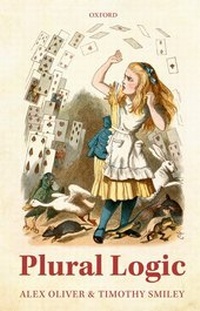
Plural Logic
Published on 30. May 2013
Book
Hardback
352 pages
978-0-19-957042-3 (ISBN)
Description
Alex Oliver and Timothy Smiley provide a natural point of entry to what for most readers will be a new subject. Plural logic deals with plural terms ('Whitehead and Russell', 'Henry VIII's wives', 'the real numbers', 'the square roots of -1', 'they'), plural predicates ('surrounded the fort', 'are prime', 'are consistent', 'imply'), and plural quantification ('some things', 'any things'). Current logic is singularist: its terms stand for at most one thing. By contrast, the foundational thesis of this book is that a particular term may legitimately stand for several things at once; in other words, there is such a thing as genuinely plural denotation. The authors argue that plural phenomena need to be taken seriously and that the only viable response is to adopt a plural logic, a logic based on plural denotation. They expound a framework of ideas that includes the distinction between distributive and collective predicates, the theory of plural descriptions, multivalued functions, and lists. A formal system of plural logic is presented in three stages, before being applied to Cantorian set theory as an illustration.
Technicalities have been kept to a minimum, and anyone who is familiar with the classical predicate calculus should be able to follow it. The authors' approach is an attractive blend of no-nonsense argumentative directness and open-minded liberalism, and they convey the exciting and unexpected richness of their subject. Mathematicians and linguists, as well as logicians and philosophers, will find surprises in this book.
Technicalities have been kept to a minimum, and anyone who is familiar with the classical predicate calculus should be able to follow it. The authors' approach is an attractive blend of no-nonsense argumentative directness and open-minded liberalism, and they convey the exciting and unexpected richness of their subject. Mathematicians and linguists, as well as logicians and philosophers, will find surprises in this book.
Reviews / Votes
In their clear and combative style, they introduce the relevant notions and offer rebuttals to arguments that would oppose their own positions... Oliver and Smiley's book is full of careful and precise developments, as well as witty arguments... provides a good survey of plural logic and the most important issues connected to it David A. Nicolas, Notre Dame Philosophical Reviews A veritable tour de force. Lloyd Humberstone, Australasian Journal of Philosophy Throughout the book the exposition is clear; the arguments cogent; the formalism as transparent as can be. Proofs are relegated to appendices. This is a rewarding book. It deserves study in any course in philosophical or mathematical logic, and a place in every logicians library Louis F Goble, zbmathMore details
Language
English
Place of publication
Oxford
United Kingdom
Target group
College/higher education
Professional and scholarly
Dimensions
Height: 240 mm
Width: 162 mm
Thickness: 29 mm
Weight
682 gr
ISBN-13
978-0-19-957042-3 (9780199570423)
Copyright in bibliographic data and cover images is held by Nielsen Book Services Limited or by the publishers or by their respective licensors: all rights reserved.
Schweitzer Classification
Other editions
Additional editions
Book
11/2016
2nd Edition
Oxford University Press
€43.93
Shipment within 15-20 days
E-Book
06/2013
2nd Edition
OUP eBook
€18.99
Available for download
Persons
Alex Oliver read philosophy at Cambridge and Yale. After a Research Fellowship at Gonville and Caius College, Cambridge, he joined the Faculty of Philosophy where he is now a Professor. He was awarded a Leverhulme Major Research Fellowship and the Mind Association's Senior Research Fellowship for work in logic. He also has a strong interest in philosophy and public affairs, and is a Fellow of the Judge Business School. Timothy Smiley studied logic and philosophy at the University of Fribourg in Switzerland in 1948, before reading mathematics at Cambridge. After service in the RAF and the Air Ministry he was called to the Bar at Gray's Inn, but opted to take up a Research Fellowship at Clare College, Cambridge. He became Senior Tutor of his College and was a University Lecturer in Philosophy before being elected as Knightbridge Professor in 1980.
Content
1. The project ; 2. History ; 3. Changing the subject ; 4. Predicative analyses ; 5. Terms-singular and plural ; 6. The indeterminacy of plural denotation ; 7. Some basic ideas of plural logic ; 8. Plural descriptions ; 9. Multivalued functions ; 10. Lists ; 11. Singular logic ; 12. Mid-plural logic ; 13. Full plural logic ; 14. Cantorian set theory ; Postscript: unfinished business ; Principal symbols ; Glossary ; References ; Index