

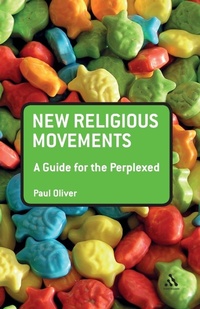
New Religious Movements: A Guide for the Perplexed
A Guide for the Perplexed
Published on 2. February 2012
Book
Paperback/Softback
192 pages
978-1-4411-0197-6 (ISBN)
Description
This is an exploration of 'new' religious movements which have originated since 1950, setting them within their social and cultural context. "New Religious Movements: A Guide for the Perplexed" examines the phenomenon of new faiths and alternative spiritualities which has become a feature of the contemporary world. Those interested in the spiritual dimension to life are no longer limited to the major world faiths, but can draw upon a rapidly-expanding range of new religions. Some of these are derived from the major religions, some are a reworking of ancient traditions, while others signify a completely new departure in spiritual experience. This book analyses the concepts we use to discuss new religions, and surveys a range of different movements which were established in the second half of the 20th century. Paul Oliver explores the organization of the movements, and the psychological aspects of life within them; the distribution of power and authority within movements; the position of women in relation to such organizations; and finally, the nature of the evolution and expansion of such movements in relation to post-modern society.
This book is ideal for students wishing to understand the more perplexing elements of this contemporary phenomenon. "Continuum's Guides for the Perplexed" are clear, concise and accessible introductions to thinkers, writers and subjects that students and readers can find especially challenging - or indeed downright bewildering. Concentrating specifically on what it is that makes the subject difficult to grasp, these books explain and explore key themes and ideas, guiding the reader towards a thorough understanding of demanding material.
This book is ideal for students wishing to understand the more perplexing elements of this contemporary phenomenon. "Continuum's Guides for the Perplexed" are clear, concise and accessible introductions to thinkers, writers and subjects that students and readers can find especially challenging - or indeed downright bewildering. Concentrating specifically on what it is that makes the subject difficult to grasp, these books explain and explore key themes and ideas, guiding the reader towards a thorough understanding of demanding material.
Reviews / Votes
New Religious Movements, A Guide for the Perplexed...has significant strengths. Through its easy form and language, demanding material is made accessible to readers with little prior knowledge of the subject. -- Margrethe Loov, MF Norwegian School of Theology * Nova Religio: The Journal of Alternative and Emergent Religions, Vol. 17, No. 1 *More details
Series
Language
English
Place of publication
New York
United States
Target group
College/higher education
Dimensions
Height: 216 mm
Width: 140 mm
Thickness: 11 mm
Weight
249 gr
ISBN-13
978-1-4411-0197-6 (9781441101976)
Copyright in bibliographic data and cover images is held by Nielsen Book Services Limited or by the publishers or by their respective licensors: all rights reserved.
Schweitzer Classification
Other editions
Additional editions
E-Book
12/2011
1st Edition
Continuum Publishing Corporation
€28.49
Available for download
E-Book
12/2011
1st Edition
Bloomsbury Continuum
€28.49
Available for download
Person
Paul Oliver is Principal Lecturer in the School of Education and Professional Development at the University of Huddersfield, UK.
Content
Part I: Philosophical Issues and New Religious Movements; 1. Conceptual Analysis and New Religious Movements; 2. Application of Concepts to New Religious Movements; Part II: A Survey of New Religious Movements; 3. Movements Related to Hinduism; 4. Movements Related to Christianity; 5. Movements Related to Buddhism; 6. Syncretistic Movements; 7. A Synthesis of the Main Ideas; Part III: Sociological and Psychological Themes in New Religious Movements; 8. Psychological Themes in New Religious Movements; 9. Gender and Diversity; 10. Power and Authority; 11. Postmodernism and the Development of New Religious Movements; Glossary; Bibliography; Index.