

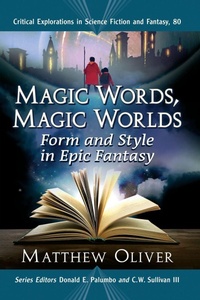
Magic Words, Magic Worlds
Form and Style in Epic Fantasy
Published on 24. June 2022
Book
Paperback/Softback
284 pages
978-1-4766-8713-1 (ISBN)
Description
While all fiction uses words to construct models of the world for readers, nowhere is this more obvious than in fantasy fiction. Epic fantasy novels create elaborate secondary worlds entirely out of language, yet the writing style used to construct those worlds has rarely been studied in depth. This book builds the foundations for a study of style in epic fantasy. Close readings of selected novels by such writers as Steven Erikson, Ursula Le Guin, N. K. Jemisin and Brandon Sanderson offer insights into the significant implications of fantasy's use of syntax, perspective, paratexts, frame narratives and more. Re-examining critical assumptions about the reading experience of epic fantasy, this work explores the genre's reputation for flowery, archaic language and its ability to create a sense of wonder. Ultimately, it argues that epic fantasy shapes the way people think, examining how literary representation and style influence perception.
Reviews / Votes
"[A] strong, well-written, and thoroughly researched book, and it addresses a topic of scholarly concern (i.e., epic fantasy) that has been woefully neglected in the secondary literature."-Dennis Wilson Wise, University of Arizona "Matthew Oliver's Magic Words, Magic Worlds moves off the paved paths of fantasy scholarship based on rhetorics and definitions. Finally we have a rich and detailed consideration of style itself, which leads Oliver into perhaps the most overlooked yet engaging feature of the genre: affect. Scholars, just as much as lovers of the genre, will discover a 'gramarye' of fantasy here, with all the abundance that term affords."-James Gifford, professor of English, Fairleigh Dickinson UniversityMore details
Series
Language
English
Place of publication
Jefferson, NC
United States
Target group
Professional and scholarly
Interest Age: From 18 years
Product notice
Paperback (trade)
Illustrations
notes, bibliography, index
Dimensions
Height: 229 mm
Width: 152 mm
Thickness: 18 mm
Weight
468 gr
ISBN-13
978-1-4766-8713-1 (9781476687131)
Copyright in bibliographic data and cover images is held by Nielsen Book Services Limited or by the publishers or by their respective licensors: all rights reserved.
Schweitzer Classification
Persons
Matthew Oliver is a professor of English at Campbellsville University in Campbellsville, Kentucky.
Content
Table of Contents
Acknowledgments
Preface
Introduction: Building Worlds with Words in Epic Fantasy
Section I: Syntactic Complexity
Chapter 1.
"The Riotous Conflagration of Beauteous Language": Flowery Style, Defamiliarization, and Empathic Imagination
Chapter 2.
"A Necessary Subtraction": Simplicity, the Violent Emotion of Editing, and the Editing of Violence
Section II: Narrative Perspective
Chapter 3.
Third-Person Heroism: Authority, Omnipotent Narration, and the Distribution of Visibility
Chapter 4.
First-Person Epic Novels: Metafantasy and Fluid Perspective
Section III: Wonder
Chapter 5.
Spoiler Alert: Twists, the Sense of Wonder, and Narrative Transcendence
Chapter 6.
The Mundane Fantastic: Stylistic Magic and Genre Collisions
Section IV: Narrative Frames
Chapter 7.
Narrative Frames: Paratexts, Blurred Boundaries, and the Deconstruction of Essentialist Narrative
Chapter 8.
Frame Narratives: Historical Truth, Literal Metaphors, and Epic Irony
Chapter Notes
Works Cited
Index
Acknowledgments
Preface
Introduction: Building Worlds with Words in Epic Fantasy
Section I: Syntactic Complexity
Chapter 1.
"The Riotous Conflagration of Beauteous Language": Flowery Style, Defamiliarization, and Empathic Imagination
Chapter 2.
"A Necessary Subtraction": Simplicity, the Violent Emotion of Editing, and the Editing of Violence
Section II: Narrative Perspective
Chapter 3.
Third-Person Heroism: Authority, Omnipotent Narration, and the Distribution of Visibility
Chapter 4.
First-Person Epic Novels: Metafantasy and Fluid Perspective
Section III: Wonder
Chapter 5.
Spoiler Alert: Twists, the Sense of Wonder, and Narrative Transcendence
Chapter 6.
The Mundane Fantastic: Stylistic Magic and Genre Collisions
Section IV: Narrative Frames
Chapter 7.
Narrative Frames: Paratexts, Blurred Boundaries, and the Deconstruction of Essentialist Narrative
Chapter 8.
Frame Narratives: Historical Truth, Literal Metaphors, and Epic Irony
Chapter Notes
Works Cited
Index