

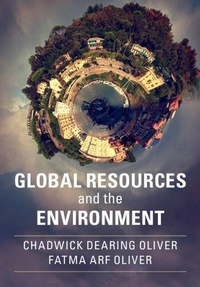
Global Resources and the Environment
Published on 21. June 2018
Book
Paperback/Softback
536 pages
978-1-316-62541-5 (ISBN)
Description
In the past few decades, sustainability of natural resources and the social and environmental issues that surround them have become increasingly topical. This multidisciplinary book discusses the complex relationships between society, natural resources and the environment. Major resources including water, agriculture, energy, minerals and forests are considered, as well as different facets of the environment including climate, landforms and biodiversity. Each resource is discussed in the context of both environmental and socio-economic factors affecting their present and future distribution and demand. Presenting a balanced, comprehensive overview of the issues surrounding natural resources and sustainability, this accessible volume will be of interest to policy makers, resource managers, graduate students and researchers in the natural and social sciences.
Reviews / Votes
'Since the United Nations Conference on Environment and Development in Rio during 1992, international agencies, national governments, non-governmental organizations, academic institutions, the media, and the public have recognized the significance of the interactions between social, environmental, and economic needs and problems. Considerable research, development, and application have emerged but interdisciplinary approaches to problems have often been lacking. This book provides a comprehensive and integrative approach to the dynamics of natural resources, the concept of sustainability, the needs and impacts of humans, and the roles of climate and biodiversity. This substantial tome is a major contribution to broader understanding and cooperation, written by outstanding authors, and will be a fundamental resource for policy-makers, managers, and academics for many years.' Jeff Burley, Oxford Forestry Institute 'In a world with increasing specialization and more well-articulated interest-groups than ever, the Olivers' book provides the opposite of the mainstream and fragmented flows of news and information. An overview and key figures describing the main components of our global production and consumption of resources are presented, analyzed, and conclusions are drawn - not only to describe problems and challenges, but mainly to illuminate potentials and possible solutions to support a highly needed sustainable development of our world society and its expected 9 billion people by 2050. Suggestions for the reader: read it, learn from it, expand your knowledge, and continue to upgrade analytical skills using this important book as your solid platform.' Palle Madsen, Forest and Landscape College, IGN, University of Copenhagen 'Chadwick and Fatma Oliver have written a magisterial work - fact-filled, comprehensive, and illuminating. I am in admiration of their accomplishment. There is nothing else like it, and it will fill a real need.' James Gustave Speth, founder and former President of World Resources Institute, and former Dean of Yale School of Forestry and Environmental Sciences 'Global Resources and the Environment is a labor of love and a wonderful achievement. It spans widely across the natural and the social sciences, as well as economics, synthesizing a huge amount of relevant literature for scientists, policymakers, and the general reader. It is also admirably positive, while clear-sighted, in its future predictions: there are still enough resources in the world, provided they are equitably distributed and managed with greater reverence and care. A wholly recommended tour de force.' Edward Davey, Project Director, World Resources Institute 'This book is an extremely helpful and timely contribution for the current or would-be professional at the international scale. It provides thorough information on the world and by region, and presents it using smart, easy-to-understand figures and graphs that synthesize a broad spectrum of knowledge. Using copious data analysis, this work carefully balances current theories and empirical lessons to propose doable actions and a promising future, but not without paying attention to dead ends and misconceptions.' Gerardo Segura, Senior Natural Resources Management Specialist, World BankMore details
Language
English
Place of publication
Cambridge
United Kingdom
Target group
Professional and scholarly
Product notice
Paperback (trade)
Illustrations
31 Tables, black and white; 13 Plates, color; 24 Maps; 169 Halftones, black and white; 40 Line drawings, black and white
Dimensions
Height: 244 mm
Width: 170 mm
Thickness: 29 mm
Weight
934 gr
ISBN-13
978-1-316-62541-5 (9781316625415)
Copyright in bibliographic data and cover images is held by Nielsen Book Services Limited or by the publishers or by their respective licensors: all rights reserved.
Schweitzer Classification
Other editions
Additional editions
Chadwick Dearing Oliver | Fatma Arf Oliver
Global Resources and the Environment
E-Book
07/2018
Cambridge University Press
€55.99
Available for download
Chadwick Dearing Oliver | Fatma Arf Oliver
Global Resources and the Environment
Book
06/2018
Cambridge University Press
€229.80
Shipment within 15-20 days
Persons
Chadwick Dearing Oliver is the Pinchot Professor of Forestry and Environmental Studies and Director of the Global Institute of Sustainable Forestry at Yale University, Connecticut. His research focuses on global issues of landscape management, and he has considerable experience advising public and private forest resource organizations in the United States and abroad. He is the author of the highly cited book Forest Stand Dynamics, now in its second edition (1996). Fatma Arf Oliver was a statistical consultant for The Boeing Company until her retirement in 2000. She is the author of scientific and technical papers.
Content
Preface; Part I. Introduction, Dynamic Systems, and Change: 1. Socio-environmental systems; 2. A perspective on dynamic systems; 3. Change, sustainability, and resilience; Part II. People: 4. Where people live, communicate, and interact; 5. People, societies, populations, and changes; 6. Resources, governments, and other social influences; Part III. Climates: 7. Global distribution of climates; 8. Greenhouse gases, atmosphere, and climates; 9. Past and future climate changes; Part IV. Landforms: 10. Landforms and soils; 11. Bedrock landforms; 12. Landforms of transported materials; Part V. Biodiversity: 13. Biodiversity: individual species; 14. Biodiversity: communities and landscapes; 15. Robust and threatened species, communities; 16. Managing biodiversity; Part VI. Water: 17. The hydrologic cycle; 18. The annual hydrograph and water use; 19. Managing and mitigating the hydrologic system; Part VII. Agriculture: 20. Food groups and nutrition; 21. Agriculture and the green revolution; 22. Future agriculture production and distribution; Part VIII. Energy: 23. Energy sources, the energy cycle, exergy; 24. Conserving energy and renewable energy; 25. Future energy: reducing fossil fuel use; Part IX. Minerals: 26. Rocks and mineral properties, mining; 27. Rocks and minerals: production, use, and distribution; Part X. Forests: 28. Forests, ecosystem services, and timber; 29. Forest distribution, area, and volume changes; 30. Silviculture, forest degradation, and landscape management; Part XI. Perspective: 31. Integrating the environment, resources, and people; Appendix I. Country groups used in analyses; Appendix II. Elements, chemical symbols, atomic numbers, and masses; Index.