

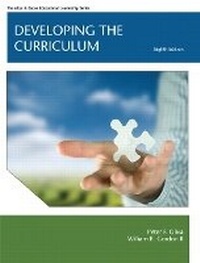
Developing the Curriculum
United States Edition
8th Edition
Published on 11. April 2012
Book
Hardback
528 pages
978-0-13-262751-1 (ISBN)
Description
In this practical resource, pre- and in-service educational administrators get step-by-step guidance in every aspect of the curriculum development process-from the underlying principles and concepts to the roles of school personnel, the components of the process, technology in curriculum and instruction, and the most up-to-date curriculum issues. An all-new chapter on The Digital Classroom gives readers a look at how technology is changing the classroom environment and helps them understand the new trends that allow today's students to compete successfully in today's global workplace. Included are numerous references to both historic and contemporary works that provide readers with an excellent synthesis of the principles and practices used to create an effective curriculum.
More details
Other editions
New editions
Book
04/2012
8th Edition
Pearson
€182.59
Article is exhausted; no reprint
Previous edition
Peter F. Oliva
Developing the Curriculum
Book
02/2008
7th Edition
Pearson
€127.74
Article exhausted; check for reprint
Persons
Peter F. Oliva, formerly professor and chairperson at Southern Illinois University, Florida International University, and Georgia Southern University, is author of numerous articles in education journals and several textbooks and is co-author of Supervision for Today's Schools, now in its 8th ed. He has served as a high school teacher, guidance counselor, and as a professor of education at the University of Florida, University of Mississippi, Indiana State University, and the University of Hawaii. He has taught summer sessions at Portland State College (Oregon), Miami University (Ohio), and Western Michigan University. He has also served as part-time instructor supervising interns at the University of Central Florida. He has traveled extensively on educational and/or governmental programs in Europe, the Middle East, and Latin America. Developing the Curriculum has been translated into Mandarin, Vietnamese, and Korean.
William R. Gordon II has served as a teacher and administrator in Orange County Florida Public Schools for the past twenty-seven years. He began his administrative career at University High School twenty years ago as a founding member of the school. Additionally, he was an assistant principal at Glenridge Middle School, Metro West Elementary School, and Bonneville Elementary School before becoming principal at Killarney Elementary School. He then moved to the principalship of Winter Park High School. Under his eleven-year tenure at Winter Park High School the school was consistently named by the State of Florida as a "High-Performing School" due to the school's rigorous curriculum and outstanding student achievement. Also, U.S. News and World Report repeatedly ranked Winter Park High School in the top one percent of high schools in the nation. He currently serves as the Executive Area Director for the East Learning Community where he is responsible for managing thirty-eight K-12 public schools.
William R. Gordon II has served as a teacher and administrator in Orange County Florida Public Schools for the past twenty-seven years. He began his administrative career at University High School twenty years ago as a founding member of the school. Additionally, he was an assistant principal at Glenridge Middle School, Metro West Elementary School, and Bonneville Elementary School before becoming principal at Killarney Elementary School. He then moved to the principalship of Winter Park High School. Under his eleven-year tenure at Winter Park High School the school was consistently named by the State of Florida as a "High-Performing School" due to the school's rigorous curriculum and outstanding student achievement. Also, U.S. News and World Report repeatedly ranked Winter Park High School in the top one percent of high schools in the nation. He currently serves as the Executive Area Director for the East Learning Community where he is responsible for managing thirty-eight K-12 public schools.
Content
PART I CURRICULUM DEVELOPMENT: Theoretical Dimensions
Chapter 1 Curriculum and Instruction Defined
Chapter 2 Principles of Curriculum Development
PART II CURRICULUM DEVELOPMENT: Roles of School Personnel
Chapter 3 Curriculum Planning: A Multi-Level, Multi-Sector Process
Chapter 4 Curriculum Planning: The Human Dimension
PART III Components of the Process
Chapter 5 Models for Curriculum Development
Chapter 6 Philosophy and Aims of Education
Chapter 7 Data-Driven Decision Making
Chapter 8 Curriculum Goals, Objectives, and Products
Chapter 9 Organizing and Implementing the Curriculum
Chapter 10 Instructional Goals and Objectives
Chapter 11 Selecting and Implementing Strategies of Instruction
Chapter 12 Evaluating Instruction
Chapter 13 Evaluating the Curriculum
PART IV CURRICULUM DEVELOPMENT: Technology in Curriculum and Instruction
Chapter 14 Digital Curriculum
PART V CURRICULUM DEVELOPMENT: Issues in Curriculum Development
Chapter 15 Current Curriculum Issues
APPENDIX
NAME & SUBJECT INDEXES
Chapter 1 Curriculum and Instruction Defined
Chapter 2 Principles of Curriculum Development
PART II CURRICULUM DEVELOPMENT: Roles of School Personnel
Chapter 3 Curriculum Planning: A Multi-Level, Multi-Sector Process
Chapter 4 Curriculum Planning: The Human Dimension
PART III Components of the Process
Chapter 5 Models for Curriculum Development
Chapter 6 Philosophy and Aims of Education
Chapter 7 Data-Driven Decision Making
Chapter 8 Curriculum Goals, Objectives, and Products
Chapter 9 Organizing and Implementing the Curriculum
Chapter 10 Instructional Goals and Objectives
Chapter 11 Selecting and Implementing Strategies of Instruction
Chapter 12 Evaluating Instruction
Chapter 13 Evaluating the Curriculum
PART IV CURRICULUM DEVELOPMENT: Technology in Curriculum and Instruction
Chapter 14 Digital Curriculum
PART V CURRICULUM DEVELOPMENT: Issues in Curriculum Development
Chapter 15 Current Curriculum Issues
APPENDIX
NAME & SUBJECT INDEXES