

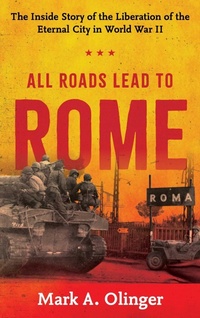
All Roads Lead to Rome
The Inside Story of the Liberation of the Eternal City in World War II
Will be published approx. on 17. November 2026
Book
Hardback
240 pages
978-0-8117-7807-7 (ISBN)
Description
In May 1944, American forces stood on the doorstep of Rome, tantalizingly close to the Eternal City after an eight-month grind up the boot of Italy—yet still so far away. Would German resistance south of the city break at last? Would Allied strategy and politics divert the Americans from the great prize? Would the city fall before D-Day shifted the world’s attention—as well as vital men and materiel—from Italy to France? Capturing all the drama and uncertainty of this pivotal moment of World War II, All Roads Lead to Rome narrates the battles—at the front line and inside headquarters—that led to the liberation of Rome.
After amphibious landings in September 1943, the Allies clawed their way up the Italian peninsula. The terrain was unforgiving, the German resistance stubborn, but by May, the Americans and British were poised to crack the last major German line south of Rome and simultaneously break out of their beachhead at Anzio. But an argument was brewing at Allied headquarters. The British, who commanded the Mediterranean theater, wanted to block and capture German troops as they retreated while U.S. commander Mark Clark had his eyes on Rome. Clark thought the British might insist on sharing the glory or shut out the Americans entirely and knew the Allies would invade Normandy within days, thus turning Italy into a backwater. The clock was ticking.
As Allied forces blasted through the German defenses, Clark ordered his army to turn toward Rome. Clark’s Fifth Army converged on the ancient city, and gritty American GI’s fought scores of small-unit battles each day—squads fighting for road crossings, companies for hills and ridges, platoons for bridges (seventeen across the Tiber alone). On June 4, 1944, U.S. forces entered the city. The Germans had abandoned it, and a large portion of their army escaped north to fight another day. Clark gained his triumph, but at the cost of another eleven months of hard fighting. D-Day began two days later, forever eclipsing his army’s accomplishment.
All Roads Lead to Rome is vital military history chronicling a signature American victory and a fraught moment for the Anglo-American alliance during World War II.
After amphibious landings in September 1943, the Allies clawed their way up the Italian peninsula. The terrain was unforgiving, the German resistance stubborn, but by May, the Americans and British were poised to crack the last major German line south of Rome and simultaneously break out of their beachhead at Anzio. But an argument was brewing at Allied headquarters. The British, who commanded the Mediterranean theater, wanted to block and capture German troops as they retreated while U.S. commander Mark Clark had his eyes on Rome. Clark thought the British might insist on sharing the glory or shut out the Americans entirely and knew the Allies would invade Normandy within days, thus turning Italy into a backwater. The clock was ticking.
As Allied forces blasted through the German defenses, Clark ordered his army to turn toward Rome. Clark’s Fifth Army converged on the ancient city, and gritty American GI’s fought scores of small-unit battles each day—squads fighting for road crossings, companies for hills and ridges, platoons for bridges (seventeen across the Tiber alone). On June 4, 1944, U.S. forces entered the city. The Germans had abandoned it, and a large portion of their army escaped north to fight another day. Clark gained his triumph, but at the cost of another eleven months of hard fighting. D-Day began two days later, forever eclipsing his army’s accomplishment.
All Roads Lead to Rome is vital military history chronicling a signature American victory and a fraught moment for the Anglo-American alliance during World War II.
More details
Person
Mark A. Olinger retired from the U.S. Army as a colonel after more than twenty-five years on active duty, including service with the 1st Infantry, 1st Armored, and 101st Airborne divisions. He lives in northeastern Texas.
Content
Table of Contents
Chapter
Retreat of the Herman Goering Panzer Parachute Division
The German Situation
Exploiting the Penetration
Race toward Rome – 3 June
Appendix A – Medal of Honor Recipients for the Liberation of Rome
Appendix B – Order of the Day, General Alexander, 11 May 1944
Appendix C – Order of the Day, Lieutenant General Mark Clark, 6 June 1944
Appendix D – Component Elements of Selected U.S. Infantry and Armored Divisions
Appendix E – Troop List of U.S. Fifth Army 22 May 1944
Appendix F – German Order of Battle 12 May 1944
Bibliography
Code Names
Index
Notes
Chapter
- Introduction
Strategic Plan- Decision to Drive on Rome
- Breakthrough and the Race to Rome
Retreat of the Herman Goering Panzer Parachute Division
The German Situation
Exploiting the Penetration
Race toward Rome – 3 June
- Entry and Liberation of Rome
- At the End of the Day
- Analysis
Appendix A – Medal of Honor Recipients for the Liberation of Rome
Appendix B – Order of the Day, General Alexander, 11 May 1944
Appendix C – Order of the Day, Lieutenant General Mark Clark, 6 June 1944
Appendix D – Component Elements of Selected U.S. Infantry and Armored Divisions
Appendix E – Troop List of U.S. Fifth Army 22 May 1944
Appendix F – German Order of Battle 12 May 1944
Bibliography
Code Names
Index
Notes