

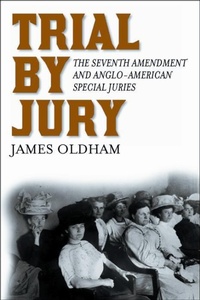
Trial by Jury
The Seventh Amendment and Anglo-American Special Juries
Published on 1. June 2006
Book
Hardback
355 pages
978-0-8147-6204-2 (ISBN)
Description
While the right to be judged by one's peers in a court of law appears to be a hallmark of American law, protected in civil cases by the Seventh Amendment to the Constitution, the civil jury is actually an import from England. Legal historian James Oldham assembles a mix of his signature essays and new work on the history of jury trial, tracing how trial by jury was transplanted to America and preserved in the Constitution.
Trial by Jury begins with a rigorous examination of English civil jury practices in the late eighteenth century, including how judges determined one's right to trial by jury and who composed the jury. Oldham then considers the extensive historical use of a variety of "special juries," such as juries of merchants for commercial cases and juries of women for claims of pregnancy. Special juries were used for centuries in both English and American law, although they are now considered antithetical to the idea that American juries should be drawn from jury pools that reflect reasonable cross-sections of their communities. An introductory overview addresses the relevance of Anglo-American legal tradition and history in understanding America's modern jury system.
Trial by Jury begins with a rigorous examination of English civil jury practices in the late eighteenth century, including how judges determined one's right to trial by jury and who composed the jury. Oldham then considers the extensive historical use of a variety of "special juries," such as juries of merchants for commercial cases and juries of women for claims of pregnancy. Special juries were used for centuries in both English and American law, although they are now considered antithetical to the idea that American juries should be drawn from jury pools that reflect reasonable cross-sections of their communities. An introductory overview addresses the relevance of Anglo-American legal tradition and history in understanding America's modern jury system.
Reviews / Votes
An impressive achievement by the leading historian of eighteenth century English law. Meticulously researched and relevant both to historical and modern debates, this book deserves a wide readership. - Thomas P. Gallanis,Professor of Law and History, Washington and Lee University Essential reading for anyone interested in trial by jury. Oldham speaks with authority about who the jurors were and what they decided. Surprisingly, he supports a 'complexity exception' to the Seventh Amendment's jury trial guarantee in civil cases. His carefully-documented history of both male and female juries of experts is uniquely valuable. No comparable work exists. - William E. Nelson,Judge Edward Weinfeld Professor of Law, NYU School of Law Oldham wonderfully complicates our historical image of the trial jury enshrined in the Sixth and Seventh Amendments of the Bill of Rights. Early English common law summoned juries of women, foreigners, experts, tradesmen, and neighbors, all deliberately chosen to bring their particular knowledge or experience to court. More than any other scholar, Oldham has revealed the manuscript sources that illuminate the context of English trial practice at the time the Bill of Rights was drafted in the newly-independent United States. - David J. Seipp,Professor of Law, Boston University School of Law This first-rate work of legal history meets the high expectations of those familiar with James Oldhams scholarship, and bears those hallmarks of excellence that we associate with that scholarship: total mastery of the manuscript and other sources, lucid exposition, fresh perspective, and sound insight. Illuminating not only the history of the jury, but the contemporary significance and judicial use of that history, this book will be enlightening for the non-specialist, and a boon to the legal historian. - Barbara A. Black,George Welwood Murray Professor of Legal History, Columbia Law School This piecemeal research is interesting to the extent that the reader is interested in reconstructing the past. (The Law and Politics Book Review)More details
Language
English
Place of publication
New York
United States
Target group
College/higher education
Professional and scholarly
Product notice
Trade binding
Dimensions
Height: 229 mm
Width: 152 mm
Thickness: 24 mm
Weight
676 gr
ISBN-13
978-0-8147-6204-2 (9780814762042)
Copyright in bibliographic data and cover images is held by Nielsen Book Services Limited or by the publishers or by their respective licensors: all rights reserved.
Schweitzer Classification
Other editions
Additional editions
E-Book
06/2006
New York University Press
€142.99
Available for download
E-Book
06/2006
New York University Press
€73.99
Available for download
Person
James Oldham is St. Thomas More Professor of Law and Legal History at Georgetown University Law Center. His books include English Common Law in the Age of Mansfield.
Content
PrefaceIntroduction 1 The Scope of the Seventh Amendment Guarantee 2 The "Complexity Exception" 3 Law versus Fact 4 Determining Damages: The Seventh Amendment, the Writ of Inquiry, and Punitive Awards 5 The Jury of Matrons 6 The Self-Informing Jury 7 The English Origins of the Special Jury 8 Special Juries in England: Nineteenth-Century Usage and Reform 9 Special Juries in the United States and Modern Jury Formation Procedures Appendix 1 Appendix 2 Appendix 3 Appendix 4 Notes Table of Statutes Table of Cases IndexAbout the Author